Exploring the legal risks of using counterfeit money.
Using fake money, particularly with the intent to defraud, is a federal crime in the U.S., punishable by up to 20 years in prison under 18 USC §514 and §472. Key points include:
Counterfeit bills must closely resemble genuine currency to deceive an honest person1.
Unknowingly using counterfeit money does not guarantee reimbursement; the last holder bears the loss2.
The average sentence for counterfeiting convictions is 17 months, with a high percentage resulting in prison time3.
Comparison of Counterfeit Laws by Country
| Country | Penalty | Imprisonment Duration | Key Points |
|---|---|---|---|
| United States | Class B felony | Up to 20 years | Intent to defraud required [4] |
| Canada | Criminal Code | Up to 14 years | Counterfeit use penalized [5] |
| China | Criminal Law | Up to 10 years | Large amounts involved [6] |
| United Kingdom | Fraud Act | Up to 10 years | Counterfeit currency use illegal |
Understanding Fake Money
Fake money encompasses various forms of currency that are not legitimate, including counterfeit bills, imitation currency, and prop money. Counterfeit money is specifically designed to mimic genuine currency to the extent that it can deceive an honest person. Under federal law, counterfeit bills must closely resemble authentic U.S. currency to qualify as such1. Imitation currency, on the other hand, may not be intended for use as legal tender but is often created for entertainment purposes, such as film productions. Prop money, a subtype of imitation currency, is commonly used in the film industry and is typically marked to indicate it is not real7.
Common uses of fake money can lead to significant legal misconceptions. Some individuals believe that using prop money for entertainment or educational purposes is entirely legal; however, this is not always the case. If prop money is too realistic, it can lead to legal repercussions, especially if someone attempts to use it as real currency4. Another misconception is that unknowingly using counterfeit money absolves one of legal consequences. In reality, individuals who unknowingly accept counterfeit bills are still financially liable, and they will not be reimbursed for the loss2.
Legal risks associated with fake money are substantial. In the United States, the act of passing or attempting to pass counterfeit money is classified as a class B felony, which can result in imprisonment for up to 20 years7. This reflects a broader trend in international laws regarding counterfeit currency. For instance, in Canada, using counterfeit money can lead to imprisonment for up to 14 years5, while in China, the penalties can also be severe, especially for large amounts6.
Understanding the definitions and implications surrounding fake money is crucial for individuals to navigate the legal landscape effectively and avoid unintentional involvement in financial crimes.
Legal Framework Surrounding Fake Money
The legal framework regarding counterfeit money varies significantly across countries, reflecting differing approaches to financial crimes. In the United States, laws governing counterfeit money are stringent. Under 18 USC §514, passing or attempting to pass fictitious obligations is classified as a class B felony, punishable by up to 20 years in prison7. Additionally, under 18 USC §472, individuals can face similar penalties for uttering counterfeit obligations or securities8. The criteria for what constitutes counterfeit money are strict; bills must closely resemble genuine U.S. currency to the extent that they can deceive an honest person1.
In Canada, the Criminal Code imposes penalties for using counterfeit money, with potential imprisonment lasting up to 14 years5. The law specifies that the mere act of using counterfeit currency is subject to prosecution, emphasizing the seriousness of the offense. In China, the stakes are equally high, where selling or purchasing counterfeit currency can lead to imprisonment of up to 10 years, particularly if the amount involved is significant6.
Key legal terms include "counterfeit money," which refers to currency designed to resemble real money with the intent to defraud, and "forgery," which encompasses the broader act of creating false documents or items for deceptive purposes. The intent to defraud is a critical component of many legal definitions surrounding counterfeit currency; without this intention, the penalties may differ significantly.
Understanding these legal frameworks is essential for individuals to navigate the risks associated with counterfeit money. Misconceptions about the legality of using fake currency, including prop money, often lead to unintentional violations. For example, the use of prop money in films must be carefully managed to avoid legal repercussions if the notes are too realistic4. Legal defenses may exist, but they often hinge on the specifics of intent and knowledge regarding the currency's authenticity.
Overall, the international landscape of counterfeit money laws underscores the need for vigilance and awareness of legal risks when dealing with any form of fake currency.
Consequences of Using Fake Money
Using fake money, particularly with fraudulent intent, carries severe legal consequences. In the United States, passing or attempting to pass counterfeit money is classified as a class B felony under 18 USC §514, which can result in a prison sentence of up to 20 years7. Similarly, under 18 USC §472, individuals can face identical penalties for uttering counterfeit obligations or securities8. The law specifies that counterfeit bills must closely resemble genuine U.S. currency to the point of deceiving an honest person1.
Statistics indicate that the average sentence for individuals convicted of counterfeiting in the U.S. is approximately 17 months, with 86.7% of those convicted receiving prison sentences3. This highlights the significant likelihood of incarceration for those found guilty of using counterfeit currency. In Canada, the Criminal Code imposes similar penalties, allowing for imprisonment of up to 14 years5. In China, individuals selling or purchasing counterfeit currency can face up to 10 years in prison if the amounts involved are substantial6.
The legal ramifications extend beyond imprisonment. Individuals who unknowingly use counterfeit money remain financially liable, as the last holder of the counterfeit bills bears the loss without any reimbursement2. This underscores the importance of being vigilant about the authenticity of currency in circulation.
Legal defenses do exist, but they often depend on proving a lack of intent to defraud. For instance, if a person can demonstrate that they were unaware the money was counterfeit and did not intend to deceive anyone, the penalties may be less severe. However, proving this can be challenging, as intent is a critical factor in determining the severity of the offense.
Understanding the potential consequences of using fake money is essential for individuals to navigate the legal landscape and avoid unintentional involvement in financial crimes.
Differences Between Counterfeiting and Other Financial Crimes
Counterfeiting is often confused with other financial crimes such as fraud and forgery, but key distinctions exist among these offenses. Counterfeiting specifically involves creating or using fake currency designed to resemble legitimate money to deceive others. According to federal law, counterfeit bills must closely mimic genuine U.S. currency to be classified as such, meaning they are calculated to deceive an honest person1. The penalties for counterfeiting in the U.S. include imprisonment for up to 20 years under 18 USC §514 and §47278.
Fraud, on the other hand, encompasses a broader range of deceptive practices intended to secure an unfair or unlawful gain. For example, a person who misrepresents their identity to obtain a loan is committing fraud but not necessarily counterfeiting. The legal definition of fraud includes acts that deceive another party for personal gain, which can result in civil and criminal penalties depending on the severity and intent of the act.
Forgery is another related crime, which involves the unauthorized alteration of documents or creating false documents with the intent to deceive. For instance, signing someone else's name on a check without permission constitutes forgery. While forgery and counterfeiting both involve deception, counterfeiting specifically pertains to currency, whereas forgery is broader and includes all types of documents.
Examples of Legal Distinctions
Counterfeiting: Producing fake $100 bills intending to use them in transactions.
Fraud: Selling a fake product while claiming it is genuine to obtain money from a buyer.
Forgery: Altering a will or contract to benefit oneself financially.
Understanding these distinctions is crucial for comprehending the legal implications of financial crimes. Engaging in any of these activities can lead to severe penalties, including imprisonment. For those unfamiliar with these laws, misconceptions can lead to unintentional violations, emphasizing the need for individuals to be aware of the specific legal definitions and risks associated with counterfeit money and related crimes.
How Law Enforcement Detects Fake Money
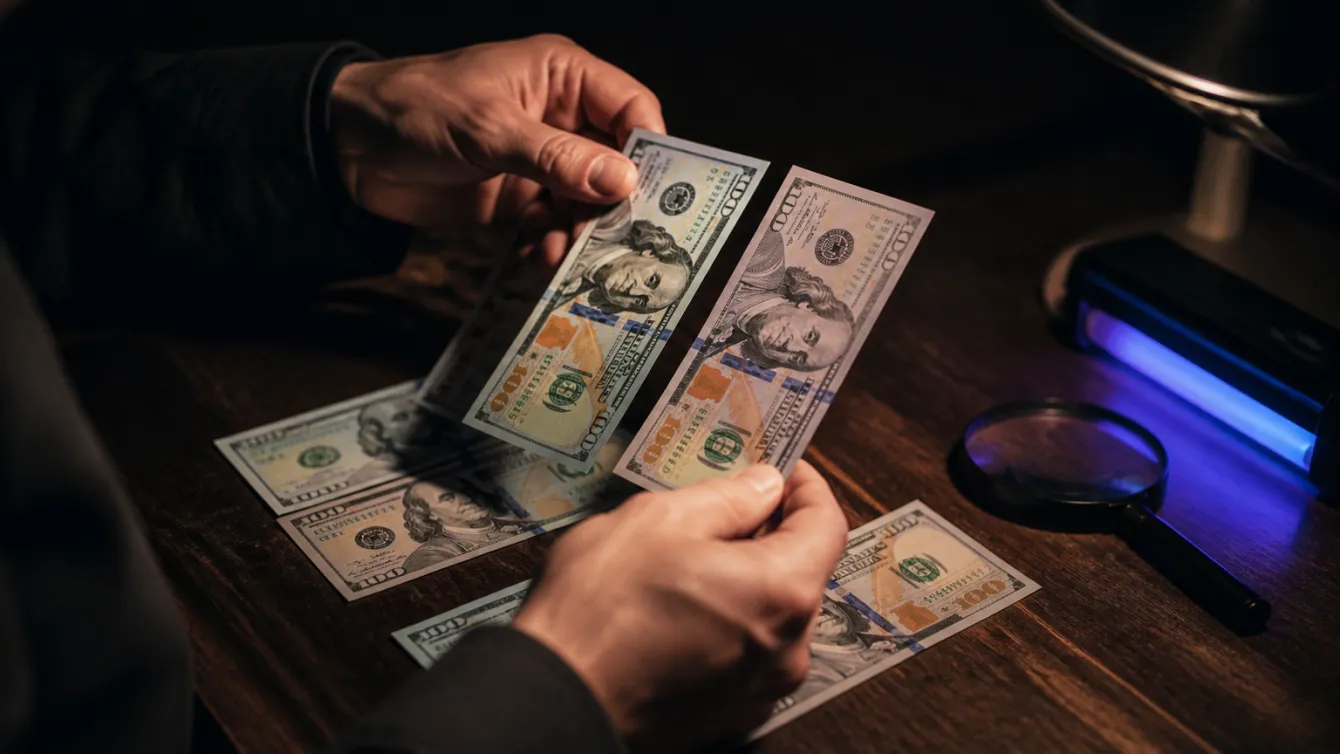
Law enforcement employs a range of methods to detect counterfeit currency, leveraging both traditional techniques and advanced technology. One of the primary tools used is the examination of physical characteristics of banknotes. Genuine U.S. currency incorporates specific features, such as watermarks, security threads, and color-shifting inks, which can be checked using a magnifying glass or specialized equipment. Officers are trained to recognize these features and to distinguish them from counterfeit notes that may lack these security elements.
Technological advancements have significantly enhanced detection capabilities. For instance, ultraviolet (UV) light scanners can reveal hidden security features present in legitimate currency. Additionally, advanced imaging technologies can analyze the ink and paper quality, providing law enforcement officials with critical information to determine a bill's authenticity. Some agencies also utilize software solutions that can instantly compare suspected counterfeit notes against a database of known counterfeits, expediting the identification process.
Collaboration with financial institutions plays a vital role in counterfeit detection. The Secret Service, which is responsible for protecting U.S. currency, partners with local banks to train staff on recognizing fake money. Banks often have sophisticated detection equipment that can identify counterfeits before they enter circulation. Reports of suspected counterfeit bills are taken seriously and promptly investigated by law enforcement, leading to swift action against offenders9.
The legal ramifications of using counterfeit currency are severe. Under federal law, passing or attempting to pass counterfeit money is classified as a class B felony, punishable by up to 20 years in prison7. This underscores the importance of vigilance in detecting fake currency. Individuals who unknowingly use counterfeit bills may face significant financial repercussions, as they are not reimbursed for losses2.
Awareness of detection methods and the legal implications surrounding counterfeit currency is essential for individuals to navigate the risks associated with fake money effectively. Understanding these practices can help prevent unintentional involvement in financial crimes, ensuring compliance with legal standards and promoting safe transactions.
Legal Defenses Against Counterfeiting Charges
Individuals charged with using fake money may have several legal defenses available, depending on the specifics of their case. The most common defense is the lack of intent to defraud. Under U.S. law, the prosecution must prove that the defendant knowingly used counterfeit currency with the intention to deceive others4. If an individual can demonstrate that they were unaware the money was counterfeit, the charges may be reduced or dismissed. For instance, if a person received counterfeit bills as change without knowledge of their authenticity, they may argue that they did not possess the required intent to commit fraud.
Another potential defense involves challenging the characterization of the currency in question. For example, if an individual possesses prop money used in film production that does not meet the legal definition of counterfeit currency—specifically, if it is not designed to deceive an honest person—they may argue that their actions did not constitute a crime1. This was highlighted in a case where a filmmaker faced charges for using realistic-looking prop money, ultimately contesting that it was not intended to be used as actual currency.
Additionally, technical defenses can be employed. Defendants may question the methods used by law enforcement to identify the counterfeit bills, arguing that the detection techniques were flawed or that the bills did not meet the legal criteria for counterfeiting. For instance, if the currency in question has characteristics that distinguish it from genuine currency but were not properly analyzed by law enforcement, this could serve as a basis for defense.
Understanding these defenses is crucial for anyone facing counterfeiting charges. Legal precedents show that successful defenses often hinge on demonstrating a lack of intent or mischaracterization of the currency involved. Individuals facing such charges should consult with legal professionals to explore the best defense strategy based on the specifics of their case.
International Perspectives on Counterfeit Money Laws
Different countries have varying approaches to laws regarding counterfeit money, reflecting their legal systems and enforcement priorities. In the United States, counterfeiting is treated as a serious federal offense. Under 18 USC §514, passing or attempting to pass counterfeit currency is classified as a class B felony, which can lead to a prison sentence of up to 20 years7. Additionally, the law stipulates that counterfeit bills must closely resemble genuine currency to be classified as such, indicating a high threshold for legal classification1.
Canada's legal framework similarly addresses counterfeit money with significant penalties. The Criminal Code allows for imprisonment of up to 14 years for individuals found guilty of using counterfeit currency5. This highlights a focused effort to combat financial crimes associated with fake money, aligning with the severe penalties seen in the U.S.
In contrast, China's approach emphasizes both the production and distribution aspects of counterfeit currency. Selling or purchasing counterfeit money can result in imprisonment of up to 10 years, particularly if the amounts involved are substantial6. This reflects a broader strategy to deter not only the use of counterfeit currency but also its circulation within the economy.
Unique methods of enforcement and detection also vary by country. In the U.S., the Secret Service plays a critical role in investigating counterfeiting cases and collaborating with financial institutions to enhance detection methods9. In Canada, law enforcement agencies conduct regular training to ensure that personnel are equipped to identify counterfeit notes effectively.
Legal defenses against counterfeit charges also differ internationally. While a lack of intent to defraud is a common defense in many jurisdictions, the specifics of these defenses can vary based on local laws and judicial interpretations. Understanding these international perspectives on counterfeit money laws is essential for individuals engaging in financial transactions across borders, as the legal risks and penalties can differ substantially.
Common Myths About Fake Money
Misconceptions about fake money can lead individuals into serious legal trouble. One common myth is that using fake currency is harmless if done unknowingly. In reality, even unintentional use of counterfeit money can result in severe penalties. Under U.S. law, individuals who pass or attempt to pass fictitious obligations face up to 20 years in prison, regardless of intent7. Therefore, ignorance of the law does not exempt one from its consequences.
Another prevalent myth is that prop money, often used in films and theater, is legal to use in any context. This is misleading. Prop money can only be used legally if it is not designed to deceive an honest person. If prop money closely resembles genuine currency, it may be classified as counterfeit, leading to potential legal challenges1. Cases have arisen where filmmakers faced charges for using realistic-looking prop money, emphasizing the need for adherence to legal definitions.
People often believe that counterfeit money can be exchanged for genuine currency without repercussions. However, this is false. Counterfeit notes cannot be redeemed and are illegal to knowingly pass. If caught, individuals may face not only fines but also imprisonment for up to 20 years8. Furthermore, if someone unknowingly uses counterfeit money, they will not be reimbursed, and the financial burden falls on the last holder2.
Lastly, some think that counterfeiting is a minor offense, not warranting serious attention from law enforcement. On the contrary, counterfeiting is treated as a significant federal crime, with the average sentence for convictions being about 17 months. A staggering 86.7% of those convicted receive prison sentences3. This underlines the seriousness with which authorities approach counterfeit currency.
Understanding these myths and the factual corrections is essential for anyone involved in financial transactions. Awareness can help individuals avoid unintentional violations and navigate the complex legal landscape surrounding counterfeit money.
Resources for Further Information
Individuals seeking to understand the legal implications of using counterfeit money can benefit from a variety of resources. These organizations and websites provide valuable information, legal guidance, and support for those navigating the complexities of counterfeit laws.
Government Agencies
The U.S. Secret Service is a key agency responsible for investigating counterfeiting cases. Their website offers resources and guidelines for recognizing counterfeit currency and understanding the legal ramifications of its use. Additionally, they provide information on how to report suspected counterfeit activity.
Legal Resources
The Legal Information Institute at Cornell Law School provides access to a comprehensive database of laws, including federal statutes related to counterfeiting, such as 18 USC §514 and 18 USC §472. These resources can help individuals understand the legal definitions and penalties associated with counterfeit money78.
Educational Websites
LegalClarity offers articles detailing the implications of using fake money, including potential penalties and defenses against counterfeiting charges. Their content is designed to educate individuals about the risks associated with counterfeit currency and provide practical advice on what to do if one unknowingly uses such money42.
International Laws
For those interested in international perspectives, the United Nations Office on Drugs and Crime (UNODC) provides insights into global counterfeiting laws and strategies for combating financial crimes. This can be particularly useful for individuals engaging in transactions across borders, as laws vary significantly by country6.
Local Law Enforcement
Local police departments often have resources and community outreach programs that educate the public about counterfeit currency. Engaging with local law enforcement can provide individuals with specific information relevant to their area, including how to report counterfeit incidents.
By utilizing these resources, individuals can gain a clearer understanding of counterfeit money laws and the potential legal risks involved. Staying informed is crucial for avoiding unintentional violations and ensuring compliance with financial regulations.
Common Mistakes and Misconceptions
Believing Unintentional Use is Harmless
Many individuals think that using counterfeit money unknowingly does not carry legal consequences. However, U.S. law stipulates that even unintentional use can lead to severe penalties, including up to 20 years in prison for passing fictitious obligations7. Ignorance of the law does not exempt individuals from prosecution, highlighting the importance of vigilance in financial transactions.
Assuming Prop Money is Always Legal
A common misconception is that prop money can be used freely in any context. This is misleading; prop money must not resemble genuine currency closely enough to deceive an honest person1. If it does, it can be classified as counterfeit, leading to legal repercussions for those who use it improperly.
Thinking Counterfeit Money Can Be Exchanged
Some believe that counterfeit notes can be exchanged for real currency without consequences. This is false; knowingly passing counterfeit money is illegal and can result in imprisonment for up to 20 years8. Moreover, individuals who unknowingly use counterfeit money will not be reimbursed, as the financial burden falls on the last holder2.
Underestimating the Severity of Counterfeiting Offenses
There is a prevalent belief that counterfeiting is a minor offense. In reality, it is treated as a significant federal crime, with an average prison sentence of about 17 months for convictions3. A substantial percentage of those convicted face imprisonment, emphasizing that authorities take counterfeiting very seriously.
Misunderstanding the Role of Law Enforcement
Some think that law enforcement does not actively pursue counterfeit cases, viewing them as trivial. On the contrary, agencies like the U.S. Secret Service are dedicated to investigating counterfeiting and work closely with financial institutions to enhance detection methods9. This underscores the importance of understanding the legal landscape surrounding counterfeit currency, as serious enforcement measures are in place.
Conclusions
Using fake money, even unknowingly, can result in severe legal penalties, including lengthy prison sentences.
Prop money must not closely resemble real currency to avoid being classified as counterfeit, emphasizing the importance of understanding its legal use.
Counterfeit money cannot be exchanged for real currency; passing it knowingly is illegal and carries significant consequences.
The severity of counterfeiting offenses is often underestimated, with strong enforcement measures in place by agencies like the U.S. Secret Service.
Awareness of the legal implications surrounding counterfeit money is crucial for anyone involved in financial transactions.
To further explore the nature of prop money, refer to What is Fake Prop Money?.
Q&A
What is the punishment for using fake money?
Using fake money with the intent to defraud is a federal crime in the U.S., punishable by up to 20 years in prison under 18 USC §514. Additionally, passing counterfeit obligations can also lead to imprisonment for up to 20 years under 18 USC §47278.
What happens if you use fake money?
If you use fake money, even unknowingly, you may face serious legal consequences. The financial burden falls on the last holder of the counterfeit currency, and you will not be reimbursed for any losses incurred2.
Will ATM detect fake money?
ATMs are equipped with technology to detect counterfeit bills. If a counterfeit note is inserted, the ATM will typically reject it, preventing the transaction from proceeding and alerting the user to the issue.
What happens if caught using fake money?
If caught using fake money, individuals may face arrest and prosecution. Legal consequences can include significant fines and imprisonment, with potential sentences reaching up to 20 years depending on the circumstances4.
Is using counterfeit money a felony or misdemeanor?
Using counterfeit money is classified as a felony under U.S. law. This classification indicates the severity of the crime, which can result in lengthy prison sentences and substantial fines4.
What are the legal defenses against counterfeit charges?
Common legal defenses against counterfeit charges include a lack of intent to defraud and proving that the individual was unaware that the money was counterfeit. The specifics of these defenses can vary by jurisdiction, emphasizing the importance of understanding local laws.
How do law enforcement agencies detect counterfeit money?
Law enforcement agencies, including the U.S. Secret Service, employ various methods to detect counterfeit money. These methods include collaboration with financial institutions, training personnel to recognize counterfeit notes, and utilizing advanced technology to identify fraudulent currency9.
Footnotes
- Arrest for movie ‘prop money’ leads to legal challenge | Miami Herald
- What Happens If You Use Counterfeit Money Without Knowing? - LegalClarity
- Counterfeiting | United States Sentencing Commission
- Is It Illegal to Buy Fake Money? Laws and Penalties - LegalClarity
- Criminal Code
- Criminal Law of the People's Republic of China
- 18 USC 514: Fictitious obligations
- 18 USC 472: Uttering counterfeit obligations or securities
- Counterfeit Investigations
Explore More on Legal Risks
Discover additional resources about legal implications.