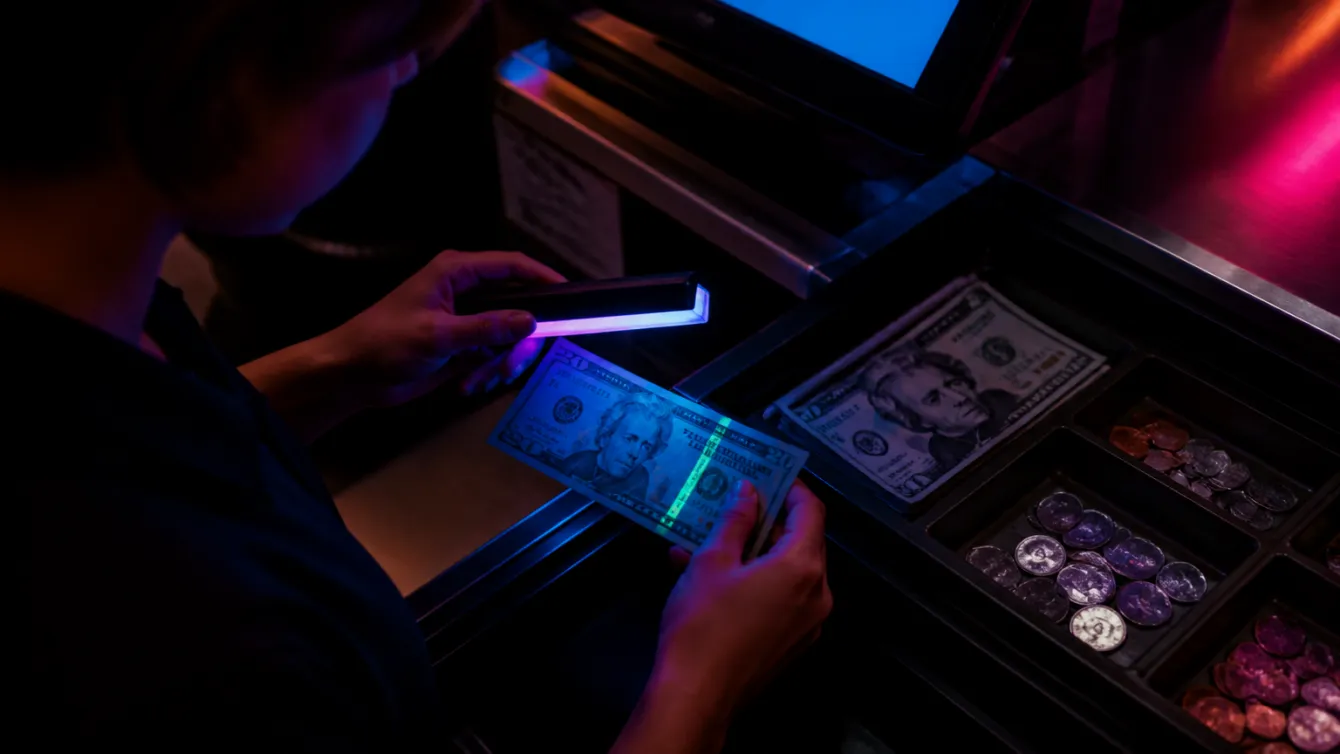
Understanding the verification of $20 bills through UV light.
To identify a fake $20 bill, check for key features: the color-shifting numeral that changes from copper to green when tilted, the embedded security thread that glows green under UV light, and the unique texture made of 75% cotton and 25% linen. Common signs of counterfeit bills include blurry borders, incorrect serial numbers, and missing security features like watermarks.
Checklist for Identifying Fake $20 Bills
| Feature | Description | Detection Method | Notes |
|---|---|---|---|
| Color-shifting numeral | Changes from copper to green | Tilt the bill | Authentic feature [1] |
| Security thread | Glows green under UV light | Use UV light | Reads 'USA TWENTY' [2] |
| Unique texture | 75% cotton, 25% linen | Feel the bill | Distinct texture [2] |
| Microprinting | Text 'USA20' on the border | Inspect closely | Difficult to replicate [3] |
| Blurry borders | Indicates counterfeit | Visual inspection | Common sign [4] |
| Incorrect serial numbers | Check for accuracy | Compare with genuine bills | Common sign [4] |
| Absence of security features | Look for watermarks | Visual inspection | Common sign [4] |
| Raised printing | Unique feel of authentic bills | Touch the bill | Recommended by U.S. Secret Service [4] |
Key Features of a Real $20 Bill
To identify a genuine $20 bill, several physical characteristics must be considered. The bill measures 6.14 inches in length and 2.61 inches in height, which is standard for U.S. currency. The predominant color of the bill is green, with a portrait of Andrew Jackson on the front and the iconic White House on the back.
A critical security feature of the $20 bill is the color-shifting numeral located in the lower right corner. This numeral transitions from copper to green when the bill is tilted, providing an easy way to verify authenticity1. Additionally, an embedded security thread runs vertically through the bill and is visible when held up to the light. Under ultraviolet light, this thread glows green and is inscribed with the text 'USA TWENTY'2.
The texture of the $20 bill is another essential indicator of authenticity. Genuine bills are printed on a special paper blend that consists of 75% cotton and 25% linen, giving them a distinct feel that is different from regular paper2. When handling the bill, the raised printing can be felt, which is a feature that counterfeit bills often lack. The U.S. Secret Service recommends checking for this unique texture during currency verification4.
Microprinting is also present on the $20 bill, specifically the text 'USA20' along the border of the blue TWENTY USA ribbon. This microprinting is challenging to replicate, making it a reliable feature for detection3.
Common signs of counterfeit bills include blurry borders, incorrect serial numbers, and the absence of security features like watermarks4. Being aware of these characteristics can help individuals and businesses avoid the risks associated with counterfeit currency, which can lead to felony charges under federal law5. If a counterfeit bill is suspected, it should be reported to the nearest U.S. Secret Service field office6.
Common Characteristics of Fake $20 Bills
Identifying counterfeit $20 bills requires attention to specific details. Common signs include poor printing quality, incorrect colors, and missing security features. Recognizing these characteristics can help prevent losses and legal issues associated with counterfeit currency.
One of the most noticeable signs of a fake $20 bill is the print quality. Genuine bills have sharp, clear images and text, while counterfeit versions often exhibit blurry borders and uneven printing. This lack of precision can be a quick indicator of counterfeit currency4.
Color discrepancies also signal potential fakes. Authentic $20 bills have a distinct green hue, particularly in the portrait of Andrew Jackson and the background. If the colors appear washed out or overly vibrant, the bill may be counterfeit. Additionally, the color-shifting numeral in the lower right corner should transition from copper to green when tilted; if it does not, this is a strong indicator of a fake1.
Security features are crucial for verifying authenticity. Genuine $20 bills contain a security thread embedded within the paper that glows green under ultraviolet light and reads 'USA TWENTY'2. If this thread is absent or does not light up, the bill is likely counterfeit. Furthermore, microprinting, which includes the text 'USA20' along the border of the blue TWENTY USA ribbon, is difficult to replicate and should be inspected closely3.
The texture of the bill is another important factor. Authentic currency is made from a unique blend of 75% cotton and 25% linen, giving it a distinct feel that counterfeit bills often lack2. The U.S. Secret Service recommends checking for raised printing, which is a tactile feature of genuine bills4.
In summary, be vigilant for blurry borders, incorrect colors, and missing security features. If a counterfeit $20 bill is suspected, it should be reported to the nearest U.S. Secret Service field office6. Understanding these characteristics can significantly reduce the risk of accepting counterfeit currency.
How to Spot a Fake $20 Bill
To effectively determine the authenticity of a $20 bill, several methods can be employed. Begin by examining the bill under different conditions, focusing on its physical characteristics and security features.
First, inspect the color-shifting numeral located in the lower right corner. This feature should change from copper to green when the bill is tilted. If the numeral does not shift colors, it is likely counterfeit1.
Next, check the texture of the bill. Authentic $20 notes are printed on a unique paper blend consisting of 75% cotton and 25% linen, giving them a distinct feel. Run your fingers across the surface; genuine bills have a raised printing that is tactile, while counterfeit bills often feel smooth or flat24.
Using ultraviolet (UV) light can also help in verification. Hold the bill under UV light to see if the embedded security thread glows green and reads 'USA TWENTY.' This thread is a crucial security feature that counterfeiters often overlook2.
Additionally, look for microprinting along the border of the blue TWENTY USA ribbon. The text 'USA20' should be visible upon close inspection. This microprinting is difficult to replicate, making it a reliable indicator of authenticity3.
Common signs of counterfeit bills include blurry borders and incorrect serial numbers. Conduct a visual inspection to check for these discrepancies, as they are often indicators of fake currency4.
If there are any suspicions about a bill's authenticity, it is essential to report it to the nearest U.S. Secret Service field office, as possessing counterfeit money can lead to felony charges under federal law56. By following these steps, individuals can better protect themselves against counterfeit currency and ensure they are handling legitimate legal tender.
Legal Implications of Using Fake Money
Passing counterfeit currency is a serious offense with significant legal consequences. Under federal law, specifically 18 USC Chapter 25, the act of using or distributing counterfeit money can result in felony charges. A conviction can lead to severe penalties, including fines that can reach up to $250,000 and imprisonment for up to 20 years5.
Individuals who knowingly attempt to pass off counterfeit bills as genuine can face harsher consequences. For example, if a person is caught using a counterfeit $20 bill, they may not only be charged with counterfeiting but could also face additional charges related to fraud or money laundering, depending on the circumstances of the case. The legal system takes these offenses seriously, as they undermine the integrity of the financial system.
In some cases, individuals may unknowingly receive counterfeit money. If this occurs, it is crucial to report the incident to the nearest U.S. Secret Service field office. Failing to report counterfeit currency can lead to complications, as law enforcement may perceive possession of counterfeit bills as intent to distribute6.
Legal prop money, which is used in films and theater, must adhere to specific regulations to avoid being classified as counterfeit. For instance, it must be more than 1½ times the size of real bills or less than ¾ the size7. This distinction is vital for those in the entertainment industry to ensure compliance with the law.
Being aware of these legal implications is essential for cashiers, business owners, and the general public. Understanding the risks associated with counterfeit currency can help individuals navigate financial transactions more safely and responsibly.
What to Do If You Receive a Fake $20 Bill
If there is suspicion that a $20 bill is counterfeit, immediate action is necessary. The first step is to stop any transaction involving the suspected bill. Do not attempt to pass it on to another person, as this can lead to felony charges under federal law5.
Next, it is advisable to examine the bill closely for common signs of counterfeiting. Key indicators include blurry borders, incorrect serial numbers, and the absence of security features like the color-shifting numeral and embedded security thread4. If these features are missing or appear faulty, the bill is likely counterfeit.
Reporting the incident is crucial. The U.S. Secret Service recommends that individuals report counterfeit currency to the nearest field office6. This agency is responsible for investigating counterfeiting and can provide guidance on the next steps. When reporting, provide as much detail as possible about how the bill was received and the circumstances surrounding it.
If you are a cashier or business owner, training staff on how to recognize counterfeit bills can help prevent losses. Regularly reviewing the security features of genuine currency, such as the unique texture derived from a blend of 75% cotton and 25% linen, can enhance detection skills2.
Additionally, if you unknowingly accept a counterfeit bill, retaining it for evidence is advisable. Do not write on it or damage it, as this may affect the investigation.
In summary, upon receiving a suspected counterfeit $20 bill, cease transactions, examine the bill for authenticity features, and report it to the U.S. Secret Service. Taking these actions can help mitigate the risks associated with counterfeit currency and ensure compliance with legal requirements.
Differences Between Prop Money and Real Currency
Prop money and real currency serve different purposes and are subject to distinct regulations. Prop money, often used in films and theater, is designed to look like real money but is not intended for actual transactions. It must adhere to specific legal guidelines to avoid being classified as counterfeit. For instance, legal prop money must be more than 1½ times the size of real bills or less than ¾ the size7. This ensures that it cannot be mistaken for genuine currency in everyday transactions.
In contrast, real currency, such as the $20 bill, contains various security features that aid in its verification. These features include a color-shifting numeral that changes from copper to green when tilted, an embedded security thread that glows under ultraviolet light, and microprinting that is difficult to replicate123. Authentic $20 bills are also made from a unique paper blend of 75% cotton and 25% linen, providing a distinct texture that prop money often lacks2.
Legal implications arise from the use of prop money as well. While prop money is legal when used appropriately, attempting to pass it off as real currency can result in felony charges under federal law, particularly if it resembles genuine currency too closely5. This highlights the importance of understanding the legal boundaries surrounding prop money usage, especially for those in the entertainment industry.
Individuals handling cash should be aware of these distinctions to avoid unintentional legal issues. Recognizing the differences between prop money and real currency can help prevent confusion and ensure compliance with regulations. Understanding these nuances is essential for cashiers, business owners, and anyone involved in cash transactions.
Resources for Further Learning
For individuals seeking to deepen their understanding of currency security and counterfeit detection, several official resources are available. The U.S. Currency website provides comprehensive information on various banknotes, including the $20 bill. This resource details the security features, such as the color-shifting numeral and embedded security thread, which are essential for identifying authentic currency12.
The U.S. Secret Service also offers valuable guidelines on how to spot counterfeit bills. Their Cashier Toolkit includes practical tips for recognizing security features and common signs of counterfeit currency, helping cashiers and business owners protect themselves against fraud6.
Additionally, the Federal Reserve provides educational materials related to currency verification and the importance of handling cash responsibly. Understanding the legal implications of counterfeit currency under 18 USC Chapter 25 is crucial for anyone involved in cash transactions, as possession of counterfeit money can lead to serious felony charges5.
For further exploration, consider visiting the U.S. Currency website and reviewing the resources available through the U.S. Secret Service. These platforms are designed to enhance public knowledge about currency security and assist individuals in making informed decisions when handling cash.
For those in the entertainment industry, understanding the legal aspects of using prop money is also important. Legal prop money must adhere to specific regulations to avoid being classified as counterfeit, ensuring compliance with the law7.
By utilizing these resources, individuals can better equip themselves to identify genuine currency and understand the risks associated with counterfeit bills, ultimately fostering a safer financial environment.
Checklist for Identifying Fake $20 Bills
Identifying counterfeit $20 bills requires a keen eye for detail. Use this checklist to verify the authenticity of a $20 bill effectively.
Security Features
Color-Shifting Numeral: Look for the numeral in the lower right corner. It should shift from copper to green when tilted. If it does not change color, the bill may be counterfeit1.
Texture: Authentic $20 bills are made from a unique blend of 75% cotton and 25% linen, giving them a distinct, textured feel. Counterfeit bills often feel smooth or flat24.
Security Thread: Check for an embedded security thread that glows green under UV light and reads 'USA TWENTY.' This feature is often overlooked by counterfeiters2.
Microprinting: Examine the border of the blue TWENTY USA ribbon for microprinting that reads 'USA20'. This text is difficult to replicate and serves as a reliable authenticity marker3.
Visual Inspection
Blurry Borders and Serial Numbers: Inspect the bill for blurry borders or incorrect serial numbers, which are common signs of counterfeiting4.
Watermark: Hold the bill up to the light to check for the watermark, which is visible from both sides. If the watermark is missing or appears different, it may be fake.
What to Do If You Suspect Counterfeiting
Do Not Pass It On: If you suspect a bill is counterfeit, do not attempt to pass it to someone else. This can lead to felony charges under federal law5.
Report to Authorities: Immediately report the counterfeit bill to your nearest U.S. Secret Service field office. Provide details about how you received it6.
Additional Tips
Regular Training: For cashiers and business owners, regular training on how to recognize counterfeit bills can help prevent losses. Familiarize staff with the security features of genuine currency2.
Legal Prop Money: Be aware of the differences between prop money and real currency. Legal prop money must be more than 1½ times the size of real bills or less than ¾ the size to avoid being classified as counterfeit7.
By following this checklist, individuals can enhance their ability to detect counterfeit $20 bills and protect themselves from potential financial losses.
Common Mistakes and Misconceptions
Believing All Fake Money Is Easily Identifiable
Many individuals think that counterfeit bills are easy to spot due to obvious flaws. In reality, counterfeiters often use advanced techniques, including bleached genuine notes, which can pass some detection methods8. This misconception can lead to a false sense of security, making individuals less vigilant when examining currency.
Assuming Prop Money Is Always Legal
There is a common belief that all prop money can be used freely without legal concerns. However, legal prop money must adhere to specific size regulations—it must be more than 1½ times or less than ¾ the size of real bills to avoid being classified as counterfeit7. Misunderstanding these regulations can result in serious legal repercussions if prop money is mistaken for genuine currency.
Ignoring the Legal Consequences of Counterfeit Currency
Some people underestimate the legal implications of using counterfeit money, believing it to be a minor issue. Possessing counterfeit currency can lead to felony charges under federal law, as outlined in 18 USC Chapter 255. This oversight can result in severe legal consequences, including fines and imprisonment.
Overlooking Security Features During Transactions
A frequent error is neglecting to check for security features on the $20 bill during transactions. Many cashiers and business owners may assume that all bills are authentic without a thorough examination. Authentic $20 bills have specific features, such as a color-shifting numeral and an embedded security thread that glows under UV light12. Failing to recognize these features can lead to financial losses.
Misunderstanding the Importance of Reporting Counterfeit Bills
Some individuals think that reporting counterfeit money is unnecessary if they receive it unknowingly. However, not reporting such incidents can complicate legal situations, as possession of counterfeit bills may be perceived as intent to distribute6. Prompt reporting to the nearest U.S. Secret Service field office is essential to avoid potential legal issues.
Conclusions
Recognize key security features of authentic $20 bills, such as the color-shifting numeral and embedded security thread.
Train staff regularly on identifying counterfeit bills to reduce potential losses.
Report any suspected counterfeit bills to the U.S. Secret Service immediately, retaining them for evidence.
Understand the legal implications of using counterfeit and prop money to avoid serious consequences.
Distinguish between prop money and real currency to ensure compliance with regulations.
For further information on identifying counterfeit bills, visit How to Spot a Fake 20 Dollar Bill.
Q&A
What to do with a fake $20 bill?
If you receive a counterfeit $20 bill, do not attempt to pass it on. Report it to your nearest U.S. Secret Service field office immediately, providing details about how you received it. This action helps mitigate risks associated with counterfeit currency and ensures compliance with legal requirements6.
Is passing a counterfeit $20 bill a felony?
Yes, passing a counterfeit $20 bill is considered a felony under federal law. Possessing counterfeit money can lead to serious legal consequences, including fines and imprisonment, as outlined in 18 USC Chapter 255.
What does a fake 20 look like?
A fake $20 bill may exhibit several signs of counterfeiting, including blurry borders, incorrect serial numbers, and the absence of security features like watermarks. Additionally, counterfeit bills often lack the distinct texture of authentic currency, which is made from a unique blend of 75% cotton and 25% linen24.
How to spot fake money 20 dollar bill?
To spot a fake $20 bill, check for key security features. Look for the color-shifting numeral that changes from copper to green when tilted, an embedded security thread that glows green under UV light, and microprinting that reads 'USA20' along the border of the blue TWENTY USA ribbon123.
Where can I find replica 20 dollar bills?
Replica $20 bills can often be found online or in stores that sell novelty items. However, it is crucial to ensure that any replica money adheres to legal guidelines, meaning it must be more than 1½ times or less than ¾ the size of real bills to avoid being classified as counterfeit7.
Fake money 20 dollar bill real or fake?
To determine if a fake $20 bill is real or counterfeit, examine it for specific security features. Authentic bills will have a color-shifting numeral, a unique texture, an embedded security thread, and microprinting that is difficult to replicate123.
Best fake money 20 dollar bill?
The best fake $20 bills are those that comply with legal standards for prop money. Legal prop money must be sized appropriately—either more than 1½ times or less than ¾ the size of real bills—to avoid being classified as counterfeit7.
Explore More on Currency Security
Discover additional resources to enhance your knowledge.