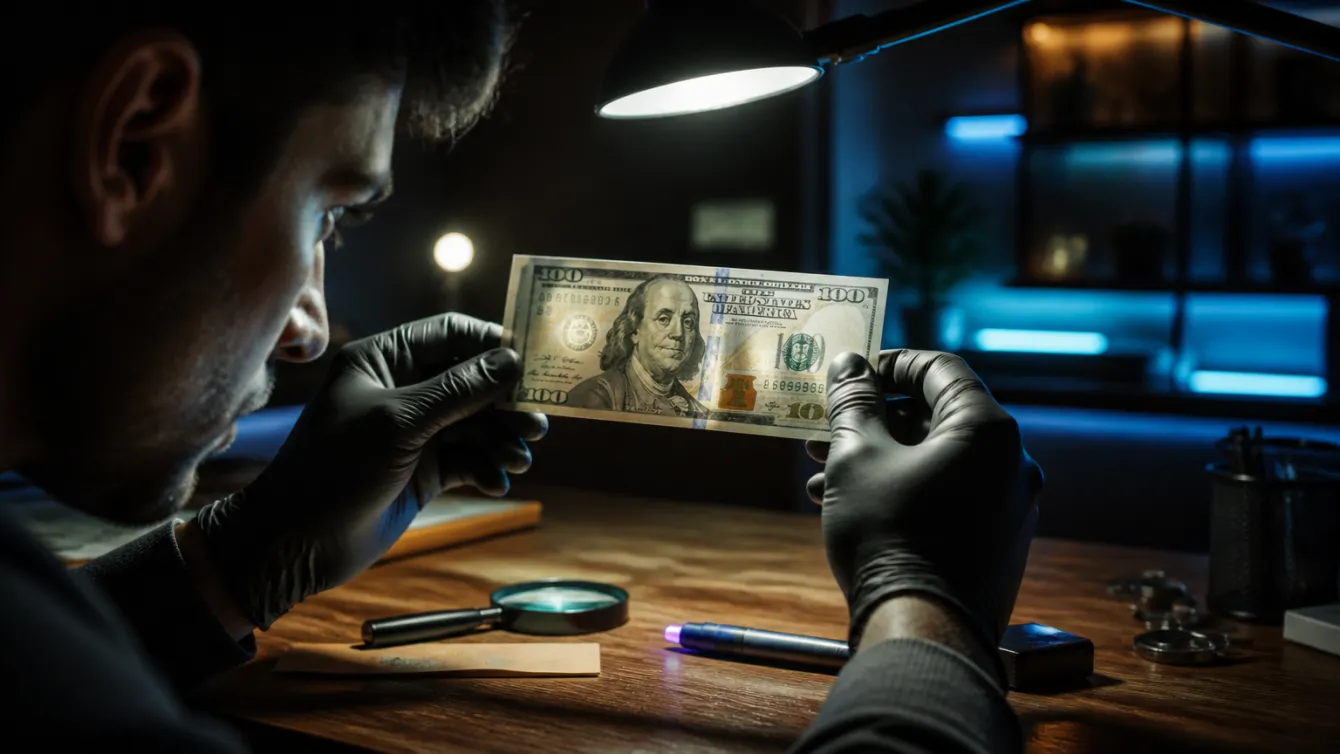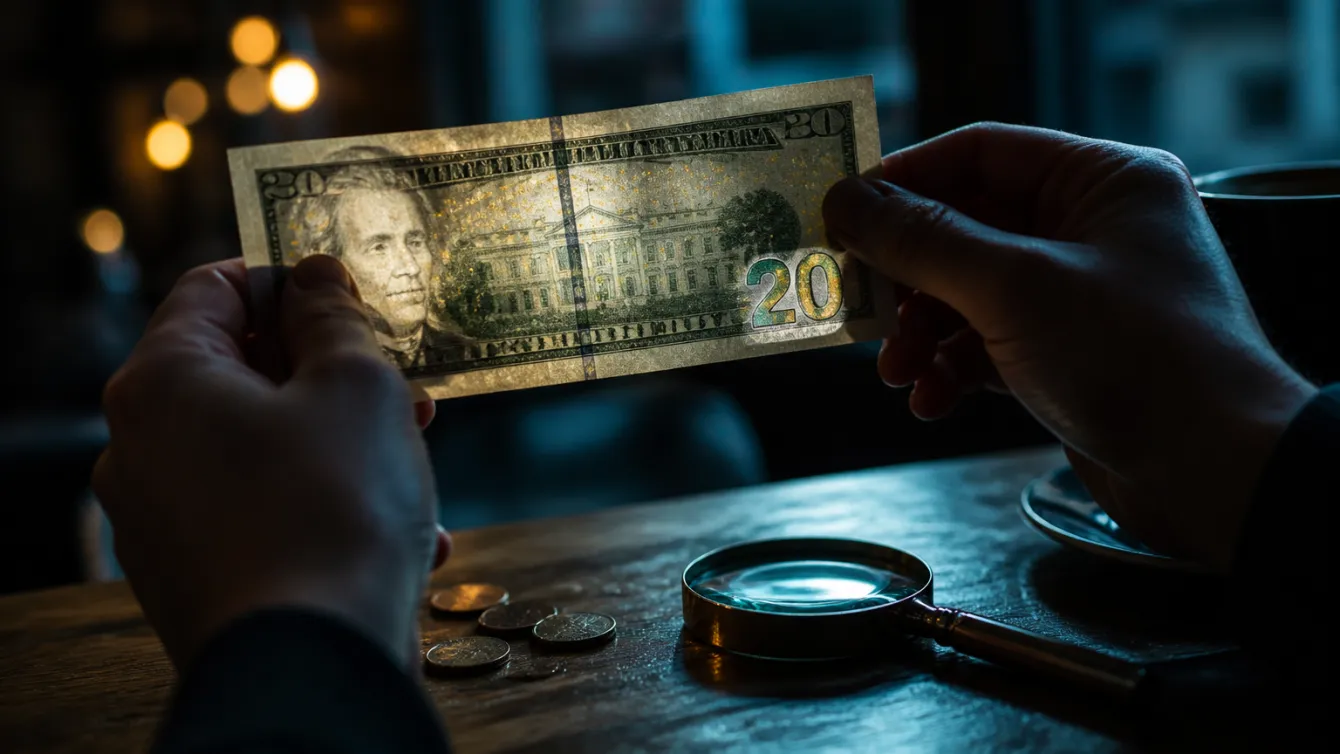
Learn to identify real $20 bills and avoid counterfeits.
To identify a fake $20 bill, check for these key security features: a watermark of Andrew Jackson visible from both sides when held to light, a color-shifting numeral '20' that changes from copper to green when tilted, and a security thread that glows green under ultraviolet light. Genuine bills are made from a unique blend of 75% cotton and 25% linen, giving them a distinct texture.
Checklist for Spotting a Fake $20 Bill
| Feature | Description | How to Check | Notes |
|---|---|---|---|
| Watermark | Andrew Jackson visible from both sides | Hold to light | Check both sides |
| Security Thread | Glows green under UV light | Use UV light | Embedded in bill |
| Color-Shifting Numeral | Changes from copper to green | Tilt the bill | Observe the numeral '20' |
| Texture | 75% cotton and 25% linen | Feel the bill | Slightly rough texture |
| Microprinting | Text 'USA20' on the border | Magnification needed | Requires a magnifying glass |
| Foreign Writing | Any foreign text present | Visual inspection | Indicates likely counterfeit |
| Feel Test | Slightly rough due to raised printing | Touch the bill | Characteristic of genuine currency |
| Detection Pens | Not always reliable | Use security features instead | Can give false results |
| Cash Assist App | Identifies denomination and features | Use mobile app | Helpful for quick checks |
| Tech Advancements | 98% accuracy in detection | Use advanced systems | Depends on technology availability |
Understanding the Security Features of a $20 Bill
The $20 bill incorporates several security features designed to prevent counterfeiting. One of the most notable is the watermark of Andrew Jackson, which is visible from both sides when the bill is held up to the light1. This feature provides an immediate visual verification that can be easily performed without any special tools.
Another key element is the security thread embedded within the bill. When viewed under a light source, this thread is visible and glows green under ultraviolet light1. This characteristic is essential for authenticating the currency, as counterfeit bills often lack this embedded feature.
Additionally, the $20 bill includes a color-shifting numeral '20'. This numeral changes from copper to green when the bill is tilted, providing a quick way to check for authenticity1. This effect is not only visually striking but also difficult to replicate accurately in counterfeit versions.
The texture of the bill also plays a crucial role in its authenticity. Genuine U.S. currency is composed of a blend of 75% cotton and 25% linen, which gives it a unique feel2. When handling a bill, it should feel slightly rough due to raised printing, a tactile feature that can be tested through a simple feel test3.
Microprinting is another security feature found on the $20 bill. This fine text, which includes the phrase 'USA20', is located along the border of the note and requires magnification to be seen clearly1. This detail is often overlooked but is an important indicator of authenticity.
For those looking to further verify the authenticity of a $20 bill, several counterfeit detection tools are available. However, caution is advised, as detection pens can sometimes yield false results4. Instead, relying on the aforementioned security features provides a more reliable method of verification.
In summary, the combination of these security features—watermark, security thread, color-shifting ink, texture, and microprinting—serves as a robust defense against counterfeit currency. Always check these elements to ensure that the $20 bill in hand is genuine.
Common Signs of a Fake $20 Bill
Identifying a counterfeit $20 bill can be straightforward if you know the common signs. Poor print quality is a primary indicator. Genuine bills are printed with precision, whereas fakes often exhibit blurry images or uneven borders. For example, the portrait of Andrew Jackson should be sharp and detailed; if it appears fuzzy, it may be a counterfeit.
Incorrect colors also signal potential fakes. The $20 bill features specific hues that are difficult to replicate accurately. If the bill appears too bright or has an unusual tint, it is worth further examination. Additionally, the color-shifting numeral '20' should transition smoothly from copper to green when tilted; any inconsistency in this effect can indicate a counterfeit1.
Lack of texture is another telltale sign. Genuine currency is made from a blend of 75% cotton and 25% linen, giving it a unique feel2. When you handle a bill, it should have a slightly rough texture due to raised printing. Counterfeit bills often feel smoother and lack this tactile quality3.
Microprinting is a security feature that can be challenging to replicate. Genuine $20 bills include the text 'USA20' along the border, which requires magnification to see clearly1. If this microprinting is absent or difficult to read, the bill is likely fake.
Lastly, look for any foreign writing or markings. If a $20 bill has text in another language or states 'For Motion Picture Use Only', it is almost certainly counterfeit5. Always perform a visual check to confirm the bill’s authenticity before accepting it.
The Feel Test: How Texture Can Help You Identify Counterfeits
The texture of a $20 bill is a key indicator of its authenticity. Genuine U.S. currency is made from a blend of 75% cotton and 25% linen, resulting in a unique feel that sets it apart from counterfeit bills, which often use cheaper materials. When you handle a legitimate $20 bill, it should feel slightly rough due to the raised printing, a characteristic that is often absent in counterfeits. To effectively perform the feel test, hold the bill between your fingers and run them across its surface, paying attention to the texture23.
To enhance the effectiveness of the feel test, consider the following tips:
Compare with a Known Genuine Bill: If possible, have a legitimate $20 bill on hand to compare the texture directly. This allows for a more accurate assessment of how the counterfeit feels in comparison.
Pay Attention to the Edges: The edges of a real bill are crisp and well-defined, while fake bills may have uneven or poorly defined edges. This can be an important tactile clue when assessing authenticity.
Check for Raised Printing: Gently run your fingernail over the bill. The raised printing on a genuine $20 bill should be noticeable. Counterfeits often lack this feature, resulting in a smoother surface3.
Consider the Overall Weight: Genuine currency has a specific weight due to its cotton-linen blend. If a bill feels unusually light or flimsy, it may be counterfeit.
Using the feel test, in conjunction with visual checks of security features like the watermark and color-shifting ink, provides a comprehensive approach to identifying counterfeit currency. This method does not require any special tools and can be performed quickly in everyday situations, making it a practical skill for anyone handling cash.
Visual Checks: What to Look For
Conducting visual checks is crucial for identifying a counterfeit $20 bill. Start with the portrait of Andrew Jackson, which should be sharp and detailed. Genuine bills exhibit clear features, while fake versions often display blurry or poorly defined images.
Next, examine the serial numbers. Authentic $20 bills have serial numbers that are evenly spaced and printed in a clear, dark ink. If the numbers appear faint or are misaligned, this indicates a potential counterfeit.
One of the standout security features is the watermark of Andrew Jackson, visible on both sides of the bill when held to light1. This is an immediate visual verification tool. Additionally, look for the embedded security thread, which glows green under ultraviolet light and is visible when the bill is held up to a light source1.
Pay special attention to the color-shifting numeral '20'. When tilted, this numeral changes from copper to green, providing a quick authenticity check1. If this effect is inconsistent or absent, the bill may be fake.
Microprinting is another important detail. Genuine $20 bills contain the text 'USA20' along the border, which requires magnification to see clearly1. If this fine print is missing or illegible, it is likely a counterfeit.
Lastly, consider the overall texture of the bill. Real currency is made from a blend of 75% cotton and 25% linen, giving it a unique feel2. A counterfeit bill may feel smoother and lack the characteristic roughness due to raised printing3.
Always combine these visual checks for a thorough assessment. Using tools like the Cash Assist mobile app can also help identify key security features of a bill6.
Using Technology to Spot Counterfeit Bills
Several tools and mobile applications are available to assist in identifying counterfeit $20 bills. These technologies leverage various security features to provide users with instant verification options.
One effective tool is the Cash Assist mobile app, which helps users identify the denomination of a bill and displays its key security features6. By simply taking a photo of the bill, users can quickly access information regarding the watermark, security thread, and color-shifting ink. This app is particularly useful for those who regularly handle cash and need a quick verification method on the go.
Additionally, advancements in computer vision technology have led to the development of systems capable of detecting counterfeit bills with over 98% accuracy7. These systems analyze multiple security features, including serial numbers and printing quality, to determine authenticity. While such technology might not be accessible to the average consumer, it is increasingly used in retail environments and by financial institutions to combat counterfeiting.
For those who prefer hands-on methods, counterfeit detection pens are available. However, these pens are not always reliable, as they can yield false results and may not effectively detect all types of counterfeit currency4. Instead of relying solely on these pens, it is advisable to use them in conjunction with the bill's inherent security features, such as the watermark and embedded security thread.
When using technology to assess a $20 bill, remember that visual and tactile checks should also be part of your verification process. Combining these methods will provide a more comprehensive approach to identifying counterfeit currency, ensuring that you are well-equipped to handle cash transactions confidently.
What to Do If You Receive a Fake $20 Bill
If you suspect that you have received a counterfeit $20 bill, it is important to handle the situation carefully and responsibly. Follow these steps to address the issue effectively.
Step 1: Do Not Attempt to Use the Bill
First, refrain from trying to spend or use the suspected counterfeit bill. Attempting to pass off a fake bill can lead to legal consequences, including criminal charges. It is essential to treat the bill as a potential piece of evidence.
Step 2: Confirm Authenticity
Before taking further action, check the bill's security features to confirm its authenticity. Look for the watermark of Andrew Jackson that is visible from both sides when held to the light1. Additionally, check for the embedded security thread that glows green under ultraviolet light1, and observe the color-shifting numeral '20' that changes from copper to green when tilted1. Utilizing these visual checks can help you determine if the bill is indeed counterfeit.
Step 3: Report the Counterfeit
If you confirm that the bill is fake, report it to the appropriate authorities. In the United States, you should contact the Secret Service, which investigates counterfeiting crimes. You can find your local Secret Service office by visiting their official website or calling their national hotline. Provide them with as much information as possible, including where and how you received the bill.
Step 4: Surrender the Bill
When reporting the counterfeit bill, you will need to surrender it to the authorities. Do not destroy or dispose of the bill, as it serves as evidence for the investigation. Keep the bill in a secure place until you can hand it over to law enforcement or a bank.
Step 5: Follow Up
After reporting the counterfeit bill, follow up with the authorities to stay informed about any developments regarding your report. You may also want to inform the establishment where you received the bill, as they may need to review their cash handling procedures.
By following these steps, you can effectively manage the situation if you receive a counterfeit $20 bill, ensuring that you do not inadvertently become involved in any illegal activities.
Legal Implications of Counterfeit Currency
Using counterfeit currency carries serious legal consequences. In the United States, individuals found guilty of counterfeiting can face significant penalties, including fines and imprisonment. The severity of the punishment often depends on the amount of counterfeit money involved and the intent of the individual. For instance, federal law stipulates that producing or passing counterfeit currency can lead to a fine of up to $250,000 and imprisonment for up to 20 years for each count of counterfeiting3.
Statistics regarding counterfeit currency cases highlight the prevalence of this issue. According to the U.S. Department of the Treasury, approximately $70 million in counterfeit currency was reported in circulation during the past year, indicating a growing concern for both consumers and law enforcement3.
The legal framework surrounding counterfeit currency is designed to deter individuals from attempting to create or use fake bills. Engaging in such activities can result not only in criminal prosecution but also in civil lawsuits from affected parties. For example, if a business unknowingly accepts a counterfeit bill and later suffers financial losses, the business may seek restitution from the individual who passed the fake currency3.
It is important to recognize that simply possessing counterfeit currency, even if one did not create it, can lead to legal repercussions. Individuals found with counterfeit bills may be charged with possession of counterfeit currency, which is a federal offense. To avoid legal trouble, it is advisable to handle any suspected counterfeit currency with caution and report it to authorities immediately3.
Understanding these legal implications underscores the importance of being vigilant when handling cash. By familiarizing oneself with the security features of genuine currency, such as watermarks and color-shifting ink, individuals can reduce their risk of unintentionally becoming involved in illegal activities related to counterfeit currency3.
Checklist: Spotting a Fake $20 Bill
To quickly identify a counterfeit $20 bill, refer to this concise checklist summarizing key points:
Security Features
Watermark: Look for the watermark of Andrew Jackson, visible from both sides when held up to the light1.
Security Thread: Check for an embedded security thread that glows green under ultraviolet light and is visible when held up to a light source1.
Color-Shifting Ink: The numeral '20' should change from copper to green when tilted1.
Microprinting: Inspect for the text 'USA20' along the border, which requires magnification to see clearly1.
Physical Characteristics
Texture: Genuine $20 bills are made from a blend of 75% cotton and 25% linen, giving them a unique texture. Counterfeit bills may feel smoother2.
Raised Printing: Run your fingernail over the bill; the raised printing should be noticeable, while counterfeit bills often lack this feature3.
Weight: Ensure the bill has a specific weight; if it feels unusually light or flimsy, it may be counterfeit.
Visual Checks
Portrait Quality: The portrait of Andrew Jackson should be sharp and detailed. Blurry or poorly defined images indicate a fake.
Serial Numbers: Authentic serial numbers should be evenly spaced and printed in clear, dark ink. Misalignment or faintness may suggest counterfeiting.
Tools and Technology
Counterfeit Detection Pens: Use these with caution, as they can yield false results. Rely more on the bill's inherent security features4.
Mobile Apps: Consider using the Cash Assist mobile app to identify key security features of the bill6.
By following this checklist, you can efficiently spot a counterfeit $20 bill and ensure your transactions are secure.
Additional Resources for Further Learning
To deepen your understanding of currency and counterfeiting, several reputable websites and government resources provide valuable information. These resources can enhance your knowledge of the security features found in genuine banknotes and the methods used to identify counterfeit currency.
Government Resources
The U.S. Department of the Treasury offers comprehensive information about currency and counterfeiting. Their official website includes educational materials on the security features of U.S. currency, including the $20 bill. Additionally, the U.S. Secret Service, which is responsible for investigating counterfeiting crimes, provides resources on how to report counterfeit currency and the legal implications involved.
Educational Materials
The Federal Reserve Bank publishes guides and articles detailing the characteristics of genuine currency. These documents explain essential security features, such as watermarks, color-shifting ink, and microprinting, which can be critical in identifying counterfeit bills. The St. Louis Fed also offers resources on detecting counterfeit currency, providing practical tips for consumers3.
Online Tools and Applications
Several online tools and mobile applications can assist in identifying counterfeit bills. The Cash Assist mobile app allows users to take pictures of bills and quickly check their security features, making it a useful resource for anyone handling cash6.
Industry Organizations
Organizations like the International Currency Association and the International Bank Note Society provide insights into currency design, production, and security features. Their websites often feature articles and research papers that delve into advancements in anti-counterfeiting technology, which can be beneficial for those interested in the topic.
By utilizing these resources, you can gain a more comprehensive understanding of currency security features and the methods used to combat counterfeiting. This knowledge not only equips you to identify counterfeit bills effectively but also raises awareness about the broader implications of counterfeiting in society.
Common Mistakes and Misconceptions
Relying Solely on Detection Pens
Many people use counterfeit detection pens as their primary method for identifying fake bills. However, these pens are not always reliable and can produce false results, leading to a misguided sense of security4. Instead, it is advisable to utilize a combination of the bill's inherent security features, such as the watermark and security thread, for more accurate verification.
Ignoring Legal Implications
Some individuals underestimate the legal consequences of using counterfeit currency, believing that possession alone will not result in penalties. In reality, possessing counterfeit bills can lead to serious legal repercussions, including fines and imprisonment3. Understanding these implications is crucial for anyone handling cash, as it emphasizes the importance of vigilance and proper verification.
Overlooking Technology Tools
There is a common belief that traditional methods are sufficient for detecting counterfeit bills, causing some to overlook modern technology. While visual checks are essential, advancements like mobile apps, such as Cash Assist, can enhance detection accuracy by providing quick access to security features6. Incorporating these tools into the verification process can significantly improve the chances of identifying counterfeit currency.
Misjudging the Feel Test
Many assume that counterfeit bills will always feel noticeably different from genuine ones. While genuine currency has a unique texture due to its cotton and linen composition, not all counterfeit bills will exhibit obvious differences2. It is essential to conduct a comprehensive examination, including visual checks and technology aids, rather than relying solely on tactile sensations.
Failing to Recognize Foreign Writing
A frequent misconception is that all bills with foreign writing can be easily identified as counterfeit. While bills marked "For Motion Picture Use Only" are certainly not legitimate5, some counterfeit bills may not have overt indicators. It is vital to examine the bill's security features thoroughly to ascertain its authenticity rather than relying on superficial signs alone.
Conclusions
Check for the watermark of Andrew Jackson visible from both sides when held up to the light.
Ensure the security thread glows green under ultraviolet light and is visible when backlit.
Look for color-shifting ink on the numeral '20', which should change from copper to green when tilted.
Verify the texture; genuine bills feel different due to their cotton and linen composition.
Use technology, such as the Cash Assist mobile app, to assist in identifying key security features.
For further insights into counterfeit currency, consider exploring the section on Identifying Fake 50 Dollar Bills.
Q&A
How can you tell if a $20 bill is counterfeit?
To determine if a $20 bill is counterfeit, check for key security features. Look for the watermark of Andrew Jackson, which is visible from both sides when held to the light1. Additionally, inspect for a security thread that glows green under ultraviolet light and is visible when backlit1.
What are the security features of a $20 bill?
The security features of a $20 bill include a watermark of Andrew Jackson, a security thread that glows green under ultraviolet light, and a color-shifting numeral '20' that changes from copper to green when tilted1. Microprinting, including the text 'USA20', is also present along the border and requires magnification to see clearly1.
What are common signs of a fake $20 bill?
Common signs of a fake $20 bill include the absence of a visible watermark, a smooth texture lacking the unique feel of genuine currency, and blurry or poorly defined images of Andrew Jackson. Additionally, counterfeit bills may have misaligned or faint serial numbers, which are typically evenly spaced and printed in clear, dark ink2.
What is the feel test for identifying counterfeit bills?
The feel test involves checking if the bill feels slightly rough due to the raised printing, which is characteristic of genuine currency3. Genuine $20 bills are made from a blend of 75% cotton and 25% linen, giving them a distinct texture that counterfeit bills may lack. Relying solely on this test is not advisable; it should be part of a comprehensive examination.
How can technology help in spotting fake bills?
Technology can assist in spotting fake bills through tools like counterfeit detection pens and mobile apps. However, detection pens can yield false results, so it's better to rely on security features of the bill4. The Cash Assist mobile app can help identify the denomination and display key security features, enhancing the verification process6.
What to do with a fake $20 bill?
If you suspect you have a fake $20 bill, do not attempt to use it. Instead, report it to local law enforcement or the U.S. Secret Service, which investigates counterfeiting crimes. Handling suspected counterfeit currency with caution is crucial to avoid legal repercussions.
Where can I find fake $20 bills that look real?
It is illegal to seek out or possess counterfeit currency, including fake $20 bills that appear real. Engaging in such activities can lead to severe legal consequences, including fines and imprisonment. It is advisable to focus on identifying genuine currency and reporting any suspected counterfeits to authorities.
Explore More on Currency Safety
Discover additional resources to enhance your knowledge.