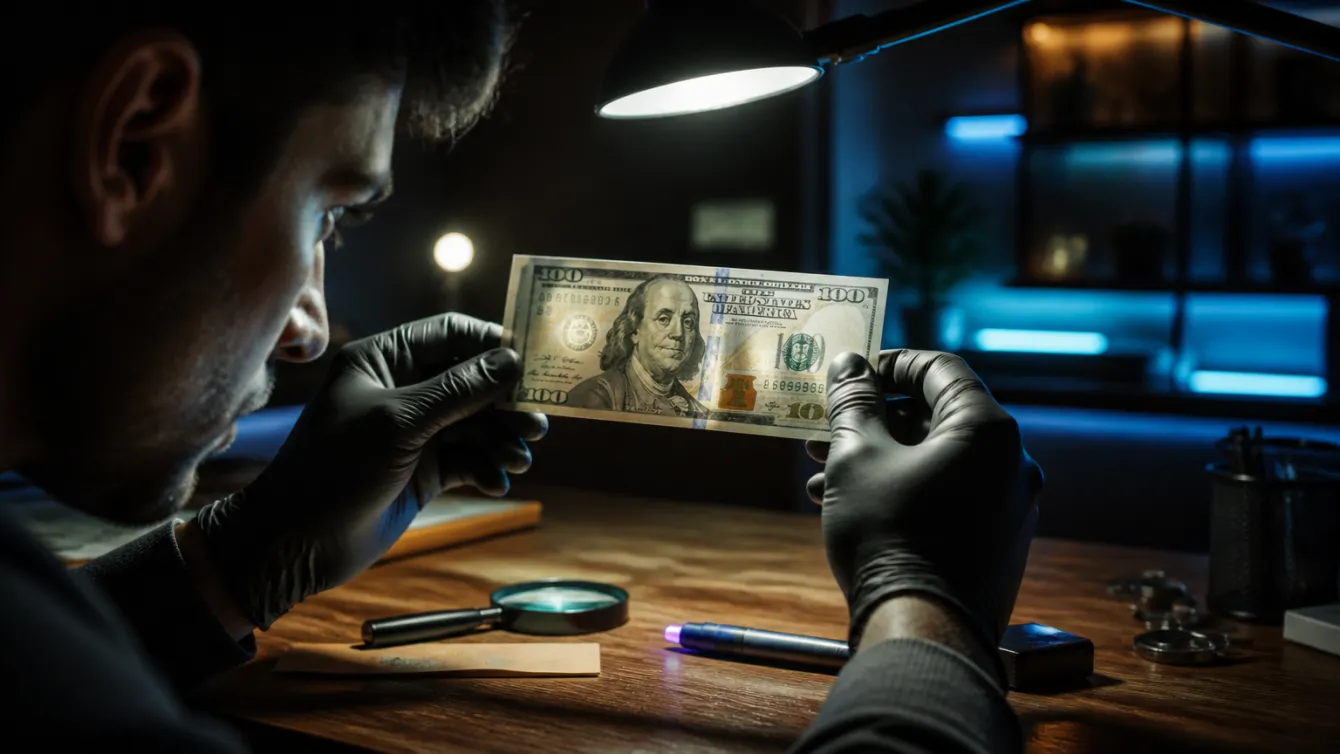
Inspecting key features of a 1996 $100 bill for authenticity.
The 1996 Series $100 bill can be identified by its unique features that help distinguish it from counterfeits. Key characteristics include an embedded security thread that glows pink under UV light, color-shifting ink that changes from green to black when tilted, and a watermark of Benjamin Franklin visible in bright light. To verify authenticity, check for the following:
Eleven numbers and letters printed twice on the front
Microprinting on the lower left corner and Franklin's lapel
Raised printing that provides a distinctive texture
Counterfeit 1996 Series $100 Bill: Key Features Checklist
| Feature | Description | How to Check | Counterfeit Indicator |
|---|---|---|---|
| Security Thread | Glows pink under UV light | Use UV light | Lacks thread or does not glow |
| Color-Shifting Ink | Changes from green to black | Tilt the bill | No color shift observed |
| Watermark | Benjamin Franklin visible in light | Hold to bright light | No watermark visible |
| Unique Numbers | Eleven numbers and letters printed twice | Inspect the front | Missing or incorrect numbers |
| Microprinting | Found on lower left and lapel | Use magnifying glass | No microprinting present |
| Raised Printing | Distinctive texture on the bill | Feel the surface | Flat or smooth texture |
| Security Fibers | Red and blue fibers in paper | Examine the paper | Fibers are absent or different |
| Faint Image | Visible Franklin image in blank space | Hold to light | No faint image present |
Key Features of the 1996 Series 100 Dollar Bill
The 1996 Series $100 bill incorporates distinct design elements that enhance its security and aesthetic appeal. One of the most notable features is the embedded security thread, which runs vertically to the left of Benjamin Franklin's portrait. This thread glows pink under ultraviolet light and is imprinted with the words "USA" and "100"1. Additionally, the bill showcases color-shifting ink that transitions from green to black when tilted, providing another layer of verification1.
A prominent watermark of Benjamin Franklin can be seen when the bill is held up to bright light. This watermark is a crucial element for identifying authenticity, as it is difficult to replicate2. The paper composition of the 1996 Series bill consists of 25% linen and 75% cotton, embedded with red and blue security fibers that contribute to its unique texture and appearance1. The presence of these fibers can be checked by examining the bill closely.
Microprinting is another critical feature found on the note, specifically in the numeral located in the lower left corner and on Franklin's lapel. This microprinting is intricate and challenging to reproduce, making it a reliable indicator of authenticity2. The raised printing on the bill adds a tactile quality that can be felt by touch, further assisting in distinguishing genuine currency from counterfeits1.
Lastly, a faint image of Benjamin Franklin is discernible in the blank space to the right of the portrait when the bill is held up to light1. The combination of these features not only enhances the visual appeal of the 1996 Series $100 bill but also significantly improves its security against counterfeiting. Counterfeit bills often lack one or more of these features, making them easier to identify3. For those handling currency, understanding these elements is essential for effective currency identification and ensuring transactions involve legitimate notes.
Common Counterfeit Characteristics
Counterfeit 1996 Series $100 bills often exhibit specific traits that can help in their identification. Understanding these characteristics is crucial for collectors, retailers, and consumers.
One of the primary indicators of a counterfeit bill is the quality of the paper. Genuine 1996 Series $100 bills are made from a unique blend of 25% linen and 75% cotton, which gives them a distinct feel and texture. Counterfeit versions may use lower-quality paper, lacking the red and blue security fibers found in authentic bills1.
Printing errors are another common issue with counterfeit bills. Unlike genuine notes, which feature precise printing, counterfeits might show blurriness or misalignment in the text and images. For example, the eleven numbers and letters printed twice on the front of the bill may be missing or incorrect1.
Texture also plays a significant role in identifying counterfeits. The raised printing on a genuine 1996 Series $100 bill creates a tactile quality that can be felt when touched1. Counterfeit bills often lack this raised texture, resulting in a flat or smooth surface.
Additionally, the embedded security features are often absent in counterfeits. Genuine bills include an embedded security thread that glows pink under ultraviolet light and is imprinted with "USA" and "100"1. Counterfeit bills may not have this thread or fail to exhibit the glow when exposed to UV light3.
Microprinting is a subtle yet critical feature found on authentic bills, particularly on the numeral in the lower left corner and on Franklin's lapel. This microprinting is difficult to replicate, making its presence a reliable indicator of authenticity2. Counterfeit bills often do not include this detail or have it poorly executed.
When verifying a bill, it is advisable to use a combination of touch, sight, and tilt to assess its authenticity, as counterfeit bills frequently lack one or more of these critical features4. If a counterfeit is suspected, it is important to report it to local authorities rather than attempting to use it3.
How to Identify a Fake 1996 $100 Bill
Identifying a counterfeit 1996 Series $100 bill involves a systematic approach using various methods. These methods include visual inspection, tactile examination, and the use of light.
Start by examining the bill under bright light. A genuine 1996 Series $100 bill features a watermark of Benjamin Franklin, which is visible when held up to light2. Additionally, look for a faint image of Franklin in the blank space to the right of the portrait, which is another security feature1.
Next, use ultraviolet (UV) light to check for the embedded security thread. This thread runs vertically to the left of Franklin's portrait and glows pink under UV light, with the words "USA" and "100" imprinted on it1. Counterfeit bills often lack this thread or do not exhibit the glow, making them easier to spot3.
Tilt the bill to observe the color-shifting ink. Authentic 1996 Series $100 bills contain ink that changes from green to black when tilted, providing a clear indication of authenticity1. If no color shift is observed, it may be a counterfeit.
For a tactile check, feel the surface of the bill. Genuine bills have raised printing that creates a distinctive texture, while counterfeit versions typically have a flat or smooth feel1. Additionally, inspect the bill closely for microprinting, which can be found in the numeral on the lower left corner and on Franklin's lapel. This microprinting is intricate and difficult to replicate2.
Finally, examine the paper quality. Authentic 1996 Series $100 bills are made from a blend of 25% linen and 75% cotton, containing red and blue security fibers1. Counterfeit bills may use inferior paper that lacks these fibers.
Utilizing a combination of these methods—sight, touch, and light—will enhance the effectiveness of your currency identification efforts4. If a counterfeit bill is suspected, report it to local authorities rather than attempting to use it3.
Security Features to Look For
The 1996 Series $100 bill incorporates several security features designed to protect against counterfeiting. Recognizing these features is crucial for validating the authenticity of the currency.
One of the most prominent security features is the watermark of Benjamin Franklin, which is visible when the bill is held up to bright light. This watermark is a reliable indicator of authenticity, as it is challenging to replicate2.
Additionally, the bill includes an embedded security thread running vertically to the left of Franklin's portrait. This thread glows pink under ultraviolet light and is printed with the words "USA" and "100"1. Counterfeit bills often lack this thread or do not exhibit the glow when exposed to UV light, making them easier to identify3.
Another key feature is the color-shifting ink used on the bill. When tilted, the ink transitions from green to black, providing a clear visual cue for authenticity1. If there is no color shift observed, the bill may be counterfeit.
Microprinting is also present on the 1996 Series $100 bill. This intricate printing can be found in the numeral located in the lower left corner and on Franklin's lapel. The microprinting is difficult to reproduce, making it a reliable sign of authenticity2. Counterfeit bills often either lack this detail or have poorly executed microprinting.
The paper composition of the 1996 Series bill is another distinguishing feature. It consists of 25% linen and 75% cotton, embedded with red and blue security fibers1. Genuine bills will have these fibers, while counterfeit versions may use lower-quality paper that lacks them.
Lastly, there is raised printing on the bill, which creates a distinctive texture that can be felt by touch1. Counterfeit bills typically have a flat or smooth surface, lacking this tactile quality.
To effectively verify the authenticity of a 1996 Series $100 bill, utilize multiple methods, including touch, sight, and tilt4. If a counterfeit is suspected, it is essential to report it to local authorities rather than attempting to use it3.
Comparing Real vs. Fake Bills
Identifying counterfeit 1996 Series $100 bills requires a keen eye for detail and an understanding of the distinct features present in authentic currency. Genuine bills exhibit various visual and tactile characteristics that are often missing or poorly replicated in counterfeits.
One of the primary features to examine is the embedded security thread, which runs vertically to the left of Benjamin Franklin's portrait. This thread glows pink when exposed to ultraviolet light and is imprinted with the words "USA" and "100"1. Counterfeit bills often lack this thread or do not exhibit the glow, making them easier to identify3.
The watermark of Benjamin Franklin is another crucial element. When held up to bright light, this watermark should be clearly visible. In contrast, counterfeit versions may either lack a watermark or have one that is poorly executed2.
Another significant feature is the color-shifting ink. Authentic bills change color from green to black when tilted. If no color shift is observed, it may indicate a counterfeit1.
Inspecting the microprinting is also essential. Genuine 1996 Series $100 bills include intricate microprinting on the numeral in the lower left corner and on Franklin's lapel, which is difficult to replicate2. Counterfeit bills often do not include this detail or have it poorly executed.
The raised printing on the bill provides a tactile quality that can be felt by touch. Genuine bills have a distinctive texture, while counterfeits typically feel flat or smooth1.
Finally, the paper composition is a key distinguishing factor. Authentic 1996 Series $100 bills are made from a blend of 25% linen and 75% cotton, embedded with red and blue security fibers1. Counterfeit bills may use lower-quality paper that lacks these fibers.
Utilizing these features—security thread, watermark, color-shifting ink, microprinting, raised printing, and paper quality—will enhance the ability to accurately identify authentic 1996 Series $100 bills. If a counterfeit is suspected, it is important to report it to local authorities rather than attempting to use it3.
What to Do If You Encounter a Counterfeit Bill
If a counterfeit 1996 Series $100 bill is suspected, immediate action is essential. The first step is to refrain from using the suspected bill for transactions. Attempting to spend or pass a counterfeit note can lead to legal consequences, including potential charges of fraud3.
Next, report the incident to local authorities. Contact the police or your local law enforcement agency and provide them with details about the situation. This includes where the bill was received, any information about the person who gave it to you, and specific observations about the bill itself. Reporting these incidents helps in tracking counterfeiting operations and protecting others from becoming victims.
When handling a suspected counterfeit bill, it is important to minimize contact with it. Avoid folding or damaging the bill, as this can hinder law enforcement investigations. Instead, place it in an envelope or a secure location to preserve any evidence.
If possible, gather additional information about the bill to assist authorities. Take note of distinguishing features, such as the absence of security elements like the embedded security thread that glows pink under ultraviolet light1, or the lack of color-shifting ink that changes from green to black when tilted1. Documenting these characteristics can provide critical information for the investigation.
Lastly, educate yourself and others about recognizing counterfeit currency. Familiarize yourself with the security features of the 1996 Series $100 bill, such as the watermark of Benjamin Franklin visible when held to light2, and the microprinting found on the numeral in the lower left corner and on Franklin's lapel2. Understanding these elements can greatly enhance your ability to identify counterfeit notes in the future.
In summary, if you suspect a counterfeit bill, do not attempt to use it. Report it to local authorities, minimize contact with the bill, gather information about its features, and educate yourself on the security characteristics of authentic currency.
The Value of 1996 Series 100 Dollar Bills
The market value of authentic 1996 Series $100 bills varies based on several factors, including condition, rarity, and demand among collectors. Generally, these bills retain their face value as legal tender, but their collectible value can exceed this amount significantly in pristine condition. For instance, uncirculated notes can fetch prices ranging from $150 to over $1,000, depending on their grade and specific printing characteristics. Collectors are particularly interested in printing errors, which can further increase a bill's worth.
Counterfeit 1996 Series $100 bills, however, hold no legal value. They are generally considered worthless and can lead to legal repercussions if attempted to be used. The presence of counterfeit bills in circulation affects the perceived value of genuine notes, as collectors and retailers may demand a premium to ensure authenticity. Factors like the bill's security features play a crucial role in determining its market value. Features such as the embedded security thread, color-shifting ink, and watermark significantly enhance the bill's authenticity and desirability among collectors12.
When assessing the value of a 1996 Series $100 bill, consider the following:
Condition: Bills in uncirculated condition are more valuable than those that show signs of wear.
Rarity: Certain printing errors or unique serial numbers can increase a bill's collectible value.
Market Demand: The popularity of the bill among collectors can fluctuate, affecting its market value.
Authenticity: Bills that are verified as authentic through their security features will command higher prices.
In conclusion, while genuine 1996 Series $100 bills can have a significant market value, counterfeit bills are devoid of worth and pose legal risks. Understanding these dynamics is essential for collectors and consumers alike. If in doubt about a bill's authenticity, utilize multiple verification methods to confirm its value and legitimacy4.
Legal Implications of Counterfeiting
Possessing or distributing counterfeit currency, including the 1996 Series $100 bill, carries serious legal consequences. Under federal law, counterfeiting is considered a felony offense, potentially resulting in substantial fines and imprisonment. Specifically, individuals found guilty of counterfeiting can face up to 15 years in prison, depending on the severity of the offense and the amount of counterfeit currency involved3.
When someone is caught attempting to use or pass a counterfeit bill, law enforcement agencies may charge them with additional crimes such as fraud or forgery. For instance, if a person knowingly tries to spend a counterfeit bill, they may be prosecuted for attempting to defraud a retailer or individual. This can lead to more severe penalties, including longer prison sentences and higher fines.
In addition to criminal charges, individuals caught with counterfeit bills may also face civil repercussions. Retailers and financial institutions may pursue restitution for losses incurred due to counterfeit transactions. This means that besides facing criminal penalties, individuals may also be liable for compensating affected parties.
It is crucial to note that even possessing a counterfeit bill can lead to legal scrutiny. If a person is found in possession of counterfeit currency, they may be required to prove they were unaware of the bill's counterfeit status. However, ignorance of the law is not typically accepted as a valid defense, making it imperative for individuals to be vigilant in verifying the authenticity of currency they receive.
In summary, the legal implications of counterfeiting currency are severe, encompassing both criminal and civil consequences. Individuals should educate themselves about recognizing counterfeit bills and report any suspicions to local authorities, as attempting to use counterfeit currency can result in significant legal troubles3.
Expert Tips for Collectors
To ensure the authenticity of a 1996 Series $100 bill, collectors should adopt a multifaceted approach that combines knowledge, careful observation, and reliable sources. First, it is essential to familiarize oneself with the key security features of the bill. Authentic notes display a unique combination of eleven numbers and letters on the front, visible in two locations1. Additionally, the embedded security thread, which glows pink under ultraviolet light and is inscribed with "USA" and "100," is a critical feature to verify1.
When purchasing, always seek reputable sources. Established currency dealers, banks, and authorized auction houses are preferred venues. These entities typically have a vested interest in maintaining their reputation and may offer guarantees of authenticity. Avoid purchasing from unverified online marketplaces or individuals where the risk of counterfeit bills is higher. If possible, request a certificate of authenticity, especially for high-value transactions.
Using various methods to verify authenticity is advisable. The U.S. Currency Education Program recommends examining the bill through touch, sight, and tilt4. For instance, the color-shifting ink should change from green to black when tilted1. Furthermore, the presence of a watermark of Benjamin Franklin is crucial; this watermark should be visible when the note is held up to bright light2.
Another important aspect is microprinting, which is found on the numeral in the lower left corner and on Franklin's lapel. This detail is challenging to replicate and should be checked closely2. Lastly, the tactile experience of the bill is significant; genuine notes have a distinct texture due to raised printing1. Counterfeit bills often feel smooth and lack this quality.
In summary, collectors should ensure they are well-informed about the features of the 1996 Series $100 bill and purchase from reputable sources. By employing a thorough verification process that includes touch, sight, and tilt, collectors can significantly reduce the risk of acquiring counterfeit currency.
Common Mistakes and Misconceptions
Relying Solely on Visual Inspection
Many individuals believe that simply looking at a bill is enough to determine its authenticity. However, counterfeit notes can often mimic visual features closely. Authentic 1996 Series $100 bills have multiple security elements that require tactile and light verification, such as the embedded security thread that glows pink under ultraviolet light1 and the watermark of Benjamin Franklin visible when held to light2. Relying only on sight can lead to overlooking these critical elements.
Ignoring the Importance of Texture
Some consumers assume that all currency feels the same and do not check the texture of the bill. Genuine 1996 Series $100 bills have a distinct texture due to raised printing, which can be felt by touch1. Counterfeit bills often lack this tactile quality, feeling flat or smooth. Not assessing the texture can result in accepting a counterfeit bill unknowingly.
Underestimating the Role of Microprinting
A common misconception is that microprinting is irrelevant to the authenticity of a bill. In reality, the 1996 Series $100 bill features microprinting that is difficult to replicate, located on the numeral in the lower left corner and on Franklin's lapel2. Failing to examine this detail can lead to accepting a counterfeit note, as many forgeries do not include this intricate feature.
Misunderstanding Legal Implications
Some people believe that possessing a counterfeit bill is a minor issue. In fact, under federal law, counterfeiting is a felony that can result in severe penalties, including substantial fines and imprisonment3. Individuals caught with counterfeit bills may also face civil repercussions, making it crucial to understand the serious legal risks associated with counterfeit currency.
Assuming All Counterfeits Are Obvious
There is a belief that counterfeit bills are easy to spot, but this is not always the case. Counterfeiters have advanced their techniques, creating notes that can closely resemble authentic currency. For instance, many counterfeit bills lack critical security features, such as the embedded security thread or color-shifting ink1. It is essential to use multiple verification methods, including touch, sight, and tilt, to accurately assess a bill's authenticity4.
Conclusions
Familiarize yourself with key security features of the 1996 Series $100 bill, including the embedded security thread and watermark.
Always purchase currency from reputable sources to minimize the risk of acquiring counterfeit bills.
Utilize multiple verification methods, such as touch, sight, and tilt, to confirm authenticity.
Understand the serious legal implications of possessing or using counterfeit currency, including potential felony charges.
Stay informed about common misconceptions regarding counterfeit detection to enhance your ability to identify fakes.
To further your understanding of counterfeit currency, consider reading about Counterfeiting Currency: An Overview.
Q&A
How to know if a 1996 $100 bill is real?
To determine if a 1996 $100 bill is real, examine its key security features. Look for the embedded security thread that glows pink under ultraviolet light and is inscribed with 'USA' and '100'1. Additionally, check for color-shifting ink that changes from green to black when tilted1, and a watermark of Benjamin Franklin visible when held up to bright light2.
How can I tell if a fake old $100 bill is real or fake?
Identifying a fake $100 bill involves checking for specific security features. Authentic bills will have an embedded security thread that glows under UV light, while counterfeit bills often lack this feature3. Additionally, examine the texture of the bill; genuine notes have a distinct raised printing that can be felt by touch1.
What are the common counterfeit characteristics of 1996 $100 bills?
Common characteristics of counterfeit 1996 $100 bills include the absence of an embedded security thread, which should glow pink under UV light1. Counterfeit bills may also lack color-shifting ink and the watermark of Benjamin Franklin that is visible when held to light2. Furthermore, counterfeit notes often feel smooth rather than having the distinct texture of genuine currency1.
What security features should I look for in a 1996 $100 bill?
Key security features to verify in a 1996 $100 bill include the embedded security thread that glows pink under UV light1, color-shifting ink that changes from green to black when tilted1, and a watermark of Benjamin Franklin visible in bright light2. Additionally, check for microprinting on the numeral in the lower left corner and on Franklin's lapel, which is difficult to replicate2.
What should I do if I receive a counterfeit bill?
If you suspect you have received a counterfeit bill, do not attempt to use it. Report the incident to local authorities immediately3. Handling counterfeit currency can lead to legal consequences, so it is crucial to act promptly and responsibly.
How much is a 1996 series $100 bill worth?
The value of a 1996 Series $100 bill can vary significantly based on its condition and rarity. While the face value is $100, uncirculated notes can fetch prices ranging from $150 to over $1,000, depending on their grade and specific printing characteristics. Factors such as printing errors can further increase a bill's worth.
How can collectors ensure they are buying authentic 1996 $100 bills?
Collectors should ensure authenticity by familiarizing themselves with key security features, such as the unique combination of eleven numbers and letters on the front1. Purchasing from reputable sources, like established currency dealers or banks, is essential. Additionally, employing verification methods that include touch, sight, and tilt can help confirm authenticity4.
Explore More on Currency Security
Delve deeper into identifying authentic bills and learn more.