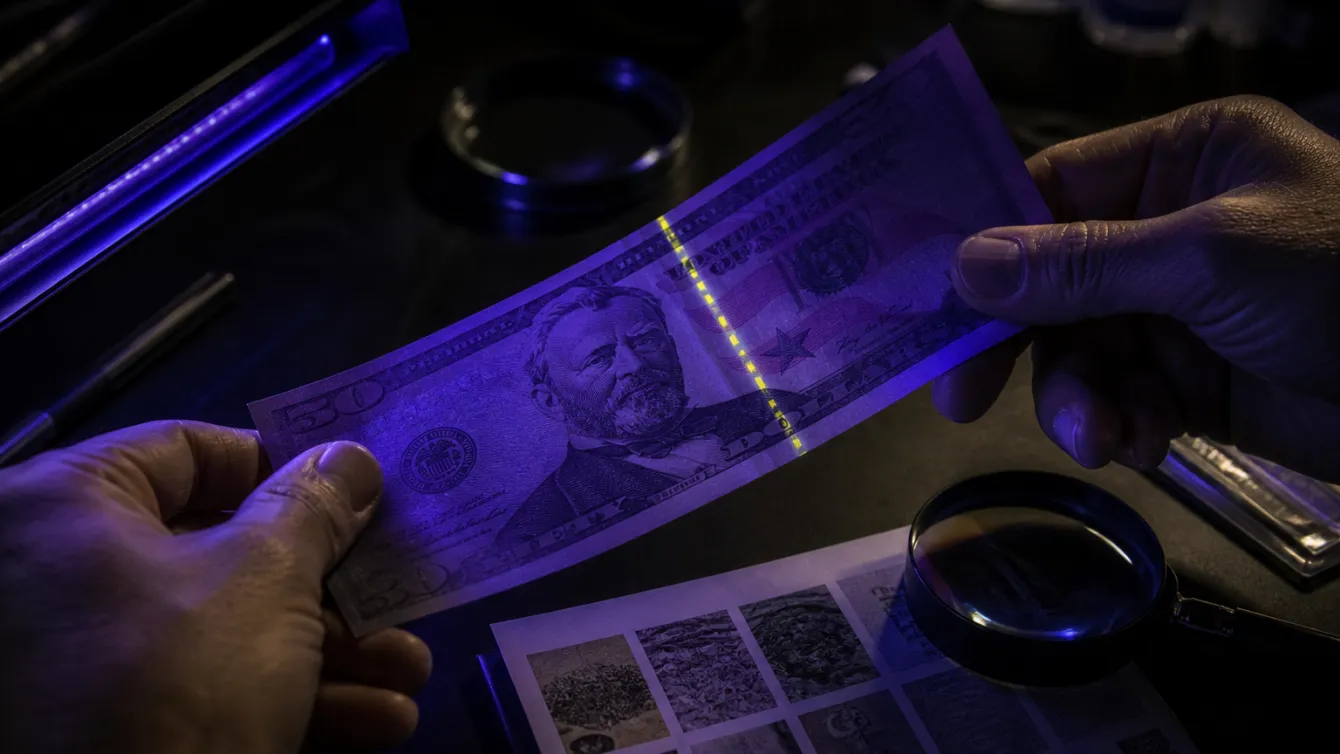
Identifying authentic $50 bills using UV light reveals hidden security features.
To identify a fake $50 bill, check for three key security features: a security thread that glows yellow under ultraviolet light, a portrait watermark, and a color-shifting numeral 50. Additionally, genuine currency has slightly raised ink that can be felt by touch. Report any counterfeit bills to the U.S. Secret Service.
Checklist for Identifying Fake $50 Bills
| Feature | Description | How to Check | Notes |
|---|---|---|---|
| Security Thread | Glows yellow under UV light | Use UV light | Imprinted with 'USA 50' |
| Portrait Watermark | Visible when held to light | Look for clear image | Should match the printed portrait |
| Color-Shifting Numeral 50 | Changes color when tilted | Tilt the bill | Should shift from copper to green |
| Raised Ink | Slightly raised texture | Feel with fingers | Distinguishes from counterfeits |
| Reporting | Report to U.S. Secret Service | Follow organization procedures | Legal penalties apply for counterfeiting |
Understanding the Design Features of a Real $50 Bill
To effectively differentiate a genuine $50 bill from a counterfeit, it is essential to understand its key design elements. The most notable features include the security thread, portrait watermark, and the color-shifting numeral 50.
The security thread is a critical component of the $50 note. It runs vertically and glows yellow when exposed to ultraviolet light, with the text 'USA 50' clearly visible on it1. This feature is designed to be easily verified with the appropriate lighting, making it a reliable method for authentication.
Another significant element is the portrait watermark, which can be seen when the bill is held up to the light. It should display a clear image that matches the printed portrait of Ulysses S. Grant, the figure depicted on the $50 note2. If the watermark is absent or appears distorted, the bill may be counterfeit.
Additionally, the numeral 50 in the bottom right corner incorporates a color-shifting feature. When the bill is tilted, the numeral changes from copper to green, providing another layer of security that is difficult to replicate in counterfeit notes2.
Genuine $50 bills also exhibit slightly raised ink, which can be felt by touch. This texture distinguishes them from counterfeits, which typically lack this tactile feature3.
Overall, understanding these design features not only aids in recognizing authentic currency but also assists in preventing fraud. Given that approximately 1 in 25,000 $50 notes is a counterfeit4, being knowledgeable about these elements significantly enhances the ability to identify fake bills.
Common Signs of a Fake $50 Bill
Counterfeit $50 bills often exhibit several distinct signs that can help in their identification. One of the most noticeable indicators is poor printing quality. Genuine bills are printed with high-resolution techniques that produce sharp, clear images and text. Counterfeit notes may appear blurry or lack the fine details found on authentic currency. Checking the overall clarity and sharpness of the print can reveal discrepancies.
Incorrect dimensions are another telltale sign. Genuine $50 bills measure 6.14 inches in length and 2.61 inches in height. If a bill deviates from these measurements, it is likely counterfeit. Using a ruler to measure the bill can provide a straightforward verification method.
Texture plays a crucial role in identification as well. Authentic $50 bills have a unique feel due to their specific paper composition and the use of slightly raised ink. This raised texture can be felt by touch, while counterfeit bills often feel flat and smooth3. Running fingers over the surface can help discern this difference.
Additionally, the security thread is a vital element that counterfeiters struggle to replicate. In genuine bills, the security thread runs vertically and glows yellow under ultraviolet light, with the text 'USA 50' imprinted on it1. If the thread is missing or does not glow, the bill should be considered suspicious.
Finally, the presence of a watermark is essential. A legitimate $50 bill features a portrait watermark of Ulysses S. Grant, which should be visible when held up to the light2. If this watermark is absent or appears distorted, it may indicate a counterfeit.
In summary, when evaluating a $50 bill, look for signs such as printing quality, dimensions, texture, security thread, and watermark. Being vigilant about these indicators can significantly reduce the risk of accepting counterfeit currency. If a counterfeit bill is suspected, it should be reported to the U.S. Secret Service, as handling counterfeit currency can lead to legal consequences, including fines or imprisonment for up to 20 years54.
How to Use Light and Technology to Spot Counterfeits
Using light and technology is an effective way to authenticate $50 bills and spot counterfeits. A common method involves ultraviolet (UV) light, which reveals hidden security features that are not visible under normal lighting conditions. The genuine $50 note contains a security thread that glows yellow when exposed to UV light. This thread runs vertically through the bill and is imprinted with the text 'USA 50'1. If a bill does not exhibit this glow, it is likely counterfeit.
Another essential feature is the portrait watermark. When held to the light, a real $50 bill displays a clear image of Ulysses S. Grant, matching the printed portrait. This watermark is a crucial aspect of currency authentication and should be checked regularly. If the watermark is unclear or absent, it raises suspicions about the bill’s authenticity2.
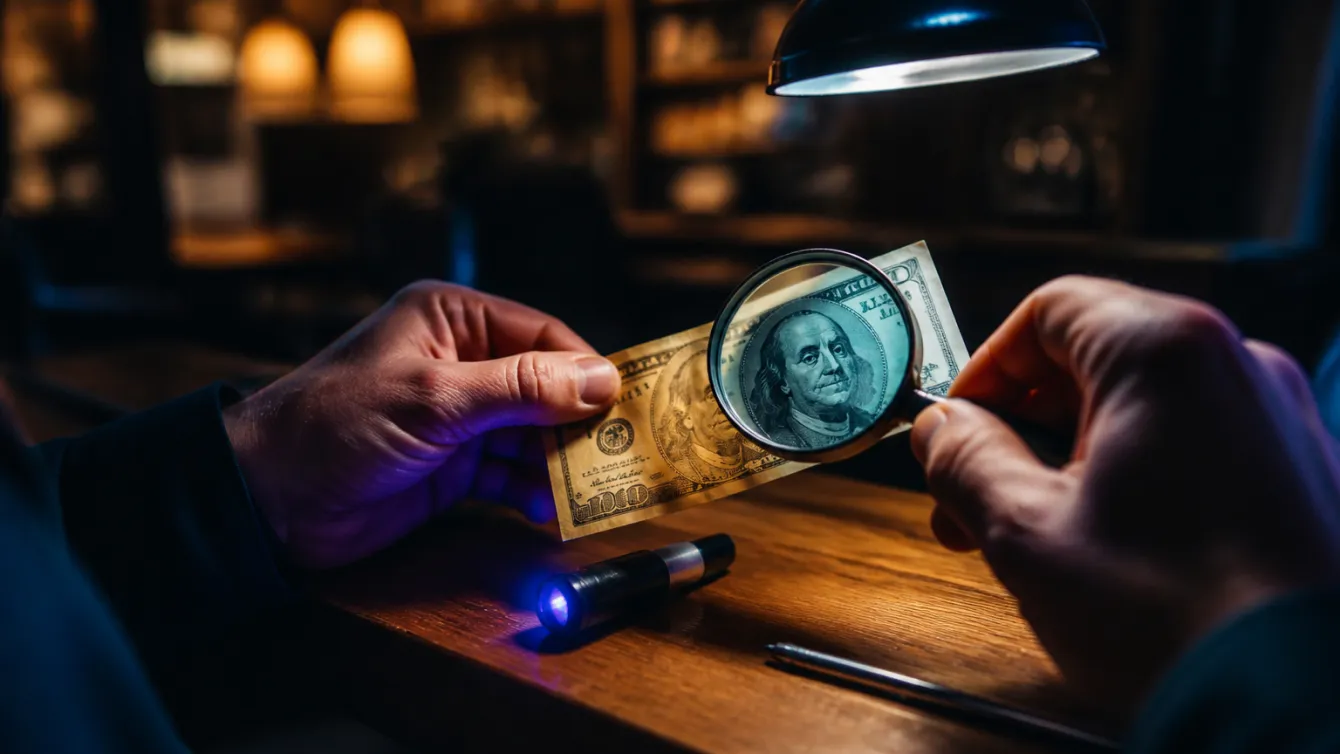
Magnifying tools can also be beneficial in examining the bill's printing quality and texture. Genuine currency has slightly raised ink, which can be felt by touch. This tactile feature is difficult to replicate in counterfeits, which typically have a smooth surface3. Using a magnifying glass, one can inspect the intricate details of the print. Look for crisp lines and sharp images; any blurriness may indicate a counterfeit.
In addition to these methods, the color-shifting numeral '50' located in the bottom right corner should be tested. When tilted, this numeral should change from copper to green, providing another layer of security2. If the color does not shift or appears inconsistent, the bill may be fake.
In summary, utilizing UV light to check the security thread, assessing the watermark with natural light, and using magnifying tools to examine printing quality and texture are effective strategies for identifying counterfeit $50 bills. Regularly applying these techniques can significantly enhance currency authentication efforts and reduce the risk of accepting fraudulent notes.
The Importance of the Security Thread and Watermark
The security thread and watermark are crucial elements in authenticating the $50 bill. These features not only enhance the security of the currency but also serve as reliable indicators for identifying counterfeits.
The security thread is embedded vertically in the bill and is imprinted with the text "USA 50." Under ultraviolet (UV) light, this thread glows yellow, making it easy to verify authenticity1. If a bill fails to exhibit this glow, it is likely counterfeit. This feature is particularly useful in environments where UV light can be easily utilized, such as retail establishments.
The portrait watermark adds another layer of security. When the bill is held up to the light, a clear image of Ulysses S. Grant should be visible, matching the printed portrait on the bill2. If the watermark is missing or appears distorted, the authenticity of the bill is compromised.
In addition, genuine $50 bills have slightly raised ink that can be felt by touch, distinguishing them from counterfeits which tend to have a flat surface3. This tactile feature, along with the visual characteristics of the security thread and watermark, provides multiple avenues for verification.
Understanding these elements is essential since approximately 1 in 25,000 $50 notes is counterfeit4. Being familiar with the security thread and watermark not only aids in recognizing authentic currency but also plays a significant role in fraud prevention. If a counterfeit bill is suspected, it should be reported to the U.S. Secret Service, as dealing in counterfeit obligations can lead to serious legal consequences, including fines or imprisonment for up to 20 years54.
Legal Consequences of Accepting Counterfeit Money
Accepting counterfeit money, even unknowingly, can lead to significant legal repercussions for both individuals and businesses. The legal framework surrounding counterfeit currency is stringent, and failing to adhere to it can result in severe penalties.
Individuals who accept counterfeit bills may face fines or imprisonment. Under 18 USC 473, dealing in counterfeit obligations can lead to imprisonment for up to 20 years, depending on the severity of the offense and the circumstances surrounding it5. This law applies even if the person did not intentionally seek out counterfeit currency.
For businesses, the consequences can be equally harsh. If a business accepts a counterfeit bill, it will not only face the loss of the amount represented by the bill but may also incur additional costs related to legal defenses if charges are brought against them. Banks typically confiscate counterfeit bills when deposited, and they will debit the business's account for the amount of the counterfeit currency6. This means that a business cannot recover lost funds from a counterfeit bill once it has been deposited.
Moreover, the IRS does not allow individuals to claim losses resulting from accepting counterfeit currency as tax-deductible losses. This means that individuals absorbing the loss from a counterfeit bill cannot offset this loss against their taxable income, further exacerbating the financial impact7.
In the event of receiving a counterfeit bill, it is crucial to report it immediately to the U.S. Secret Service. Following proper reporting procedures is not only a legal requirement but also a critical step in mitigating potential legal consequences4.
In summary, the ramifications of accepting counterfeit money can be severe, including imprisonment, financial loss, and tax implications. Understanding these legal consequences emphasizes the importance of effective currency authentication methods to prevent inadvertently accepting counterfeit bills.
What to Do If You Encounter a Fake $50 Bill
If you suspect that you have received a counterfeit $50 bill, it is crucial to take immediate action. First, handle the suspected bill carefully. Do not attempt to pass it along or use it in any transactions, as this could lead to legal consequences5.
The first step is to report the counterfeit bill to the U.S. Secret Service. This agency is responsible for investigating counterfeit currency and can provide guidance on the next steps to take4. When reporting, provide as much information as possible about where and how you received the bill.
Additionally, follow your organization’s procedures if you are in a business setting. Many establishments have protocols for handling counterfeit currency, which may include notifying a manager or security personnel.
It is also advisable to document the details surrounding the incident. Note the date, time, and location where you received the bill, along with any descriptions of the individual who gave it to you, if applicable. This information can be valuable for law enforcement.
If you have already deposited the counterfeit bill into your bank account, the bank will likely confiscate it and debit your account for the amount of the counterfeit6. This means you will lose the value of the bill, so it is essential to check your currency before making any deposits.
In summary, if you encounter a counterfeit $50 bill, do not use it, report it to the U.S. Secret Service, follow your organization's procedures, and document the incident. Understanding these steps can help mitigate the repercussions of inadvertently accepting counterfeit currency.
Comparing Old and New $50 Bills: Key Differences
The design and security features of the $50 bill have evolved significantly over the years, reflecting advancements in currency authentication and fraud prevention. The older $50 bill, which featured a more simplistic design, lacked many of the sophisticated security elements that are present in the newer version.
One of the most notable changes is the introduction of enhanced security features in the new $50 bill. The current design incorporates a security thread that glows yellow under ultraviolet light, imprinted with the text 'USA 50'1. In contrast, older bills did not have this feature, making them easier targets for counterfeiters. The newer bills also include a color-shifting numeral '50' located in the bottom right corner, which changes from copper to green when tilted, providing an additional layer of security2.
Another key difference is the watermark. The new $50 bill features a more prominent portrait watermark of Ulysses S. Grant, which is visible when the bill is held up to the light2. This feature was less defined in older versions, making it harder to authenticate. Additionally, genuine currency now has slightly raised ink, which can be felt by touch, distinguishing it from counterfeits that typically have a flat surface3.
The dimensions and overall printing quality have also seen improvements. The new bills are printed using advanced technology that enhances their durability and makes replication more difficult. This change is critical, as approximately 1 in 25,000 $50 notes is counterfeit4.
When comparing the old and new $50 bills, it is essential to focus on these design features and security enhancements. Familiarity with the differences can aid in effective currency authentication and reduce the risk of accepting counterfeit currency.
Resources for Further Learning on Currency Security
Understanding currency security is essential for effectively identifying counterfeit bills. Several credible resources can deepen knowledge in this area.
Government websites are a primary source of accurate information. The U.S. Currency Education Program provides comprehensive details on security features of U.S. currency, including the $50 bill. Their resources highlight essential elements like the security thread, watermark, and color-shifting numeral, all of which are crucial for authenticating currency24.
The U.S. Secret Service also offers valuable insights into currency security. Their site includes guidelines on reporting counterfeit currency and understanding the legal implications of dealing with counterfeit bills4. This agency is responsible for investigating counterfeit currency and provides updates on trends in counterfeiting.
Educational platforms such as the Federal Reserve’s website provide resources on how to spot counterfeit money. They offer tools and tips for recognizing security features and understanding the risks associated with accepting counterfeit currency. The Federal Reserve's publications often include statistics on the prevalence of counterfeiting, which can enhance awareness and preparedness8.
For those interested in broader topics related to currency security, resources like the Currency and Coinage section of the U.S. Department of the Treasury can be beneficial. This site discusses historical aspects of currency design and security measures taken over the years to combat counterfeiting.
Additionally, articles and research papers from financial institutions and law enforcement agencies can provide updated information on counterfeiting trends and methods. Engaging with these resources can significantly enhance understanding of currency security and fraud prevention strategies.
In summary, utilizing government websites, educational platforms, and reputable financial institutions will provide essential knowledge on currency security. Familiarity with these resources can empower individuals to effectively identify counterfeit bills and understand the legal consequences associated with counterfeit currency.
Common Mistakes and Misconceptions
Believing All Counterfeit Bills Are Easily Identifiable
Many individuals assume that counterfeit bills are obvious due to poor quality or design flaws. In reality, counterfeiters have become increasingly sophisticated, making it challenging to distinguish fake bills from genuine ones. Familiarizing oneself with the security features of currency, such as the security thread and watermark, is essential for accurate identification2.
Underestimating the Legal Consequences of Accepting Counterfeit Currency
Some people think that accepting counterfeit money is a minor issue, believing they can simply return it or that the consequences will be minimal. However, dealing in counterfeit obligations can lead to legal penalties, including fines or imprisonment for up to 20 years5. Understanding the severity of these consequences emphasizes the importance of being vigilant when handling cash.
Assuming Older $50 Bills Are Always Counterfeit
There is a common misconception that older $50 bills are automatically fake due to their age. While newer designs have enhanced security features, older bills are still valid currency. Individuals should be aware of the differences between old and new $50 bills, focusing on security elements rather than age alone2.
Not Knowing What to Do When Encountering Counterfeit Bills
Many individuals are unsure of the correct procedures to follow if they encounter a counterfeit bill. Some may attempt to use it or pass it along, which can lead to legal repercussions5. The proper course of action is to report the counterfeit to the U.S. Secret Service and follow any applicable organizational procedures4.
Overlooking the Importance of Tactile Features
People often ignore the tactile features of currency, such as the slightly raised ink present on genuine bills. This physical texture can help distinguish authentic currency from counterfeits, which typically have a flat surface3. Being aware of this feature can significantly aid in identifying counterfeit bills.
Misunderstanding the Risks of Depositing Counterfeit Currency
Some assume that if a counterfeit bill is deposited in a bank, it will not have serious repercussions. In reality, banks will confiscate counterfeit bills and debit the account for the amount of the counterfeit6. This highlights the importance of verifying currency before making deposits to avoid financial losses.
Conclusions
Familiarize yourself with the key security features of the $50 bill, such as the security thread and watermark, to effectively identify counterfeit currency.
Report any suspected counterfeit bills to the U.S. Secret Service immediately to mitigate potential legal consequences.
Understand that older $50 bills can still be valid currency; focus on security features rather than age.
Be aware of the legal implications of accepting counterfeit money, which can include fines and imprisonment.
Document details surrounding any encounter with counterfeit currency, as this information is vital for law enforcement.
Next steps include exploring how to spot other denominations, such as the How to Spot a Fake 20 Dollar Bill.
Q&A
How can you tell if a $50 bill is real?
To determine if a $50 bill is real, check for three key security features: a security thread that glows yellow under ultraviolet light, a portrait watermark of Ulysses S. Grant visible when held up to the light, and a color-shifting numeral '50' that changes from copper to green when tilted21. Additionally, genuine currency has slightly raised ink that can be felt by touch, which is absent in counterfeit bills3.
What does a fake 50 look like?
A fake $50 bill may lack the distinct security features found in a genuine bill. For instance, the security thread might not glow under UV light, and the watermark may be poorly defined or absent2. The color-shifting numeral may also remain the same color instead of changing as it should2.
How to spot a fake 50?
To spot a fake $50 bill, examine the security thread, which should glow yellow under UV light and be imprinted with 'USA 50'1. Check for the watermark of Ulysses S. Grant, which should be visible when the bill is held up to the light, and feel for the slightly raised ink that genuine currency has3.
What is the most faked dollar bill?
The most counterfeited U.S. banknote is the $20 bill, while the $100 bill is the most counterfeited internationally9. This highlights the need for vigilance when handling these denominations, as they are more frequently targeted by counterfeiters.
What should you do if you receive a counterfeit bill?
If you receive a counterfeit bill, report it to the U.S. Secret Service immediately and follow your organization's procedures for handling counterfeit currency4. Avoid using or passing the bill, as this could lead to legal consequences5. Document the details of the encounter, including where and how you received the bill, as this information is important for law enforcement.
How to spot a fake old $50 dollar bill?
To spot a fake old $50 bill, focus on the security features that may differ from newer designs. Older bills may lack the color-shifting numeral '50' and the prominent watermark of Ulysses S. Grant that newer bills have2. Check for the presence of a security thread, which may not glow under UV light in older bills, making them easier targets for counterfeiters.
What are the legal consequences of accepting counterfeit money?
Accepting counterfeit money can lead to serious legal consequences, including fines or imprisonment for up to 20 years for dealing in counterfeit obligations5. Understanding these penalties emphasizes the importance of being vigilant when handling cash.
Footnotes
- $50 Note
- $50 Note
- How to Detect Counterfeit US Money
- More Secure $50 Issued | U.S. Currency Education Program
- 18 USC 473: Dealing in counterfeit obligations or securities
- What Happens If You Take a Counterfeit Bill to the Bank?
- What to Do If You Receive a Counterfeit Bill - LegalClarity
- Estimating the Volume of Counterfeit U.S. Currency in ...
- Most Counterfeited Bill in the U.S.: $20 or $100?
Explore More on Currency Security
Discover additional resources to enhance your knowledge.