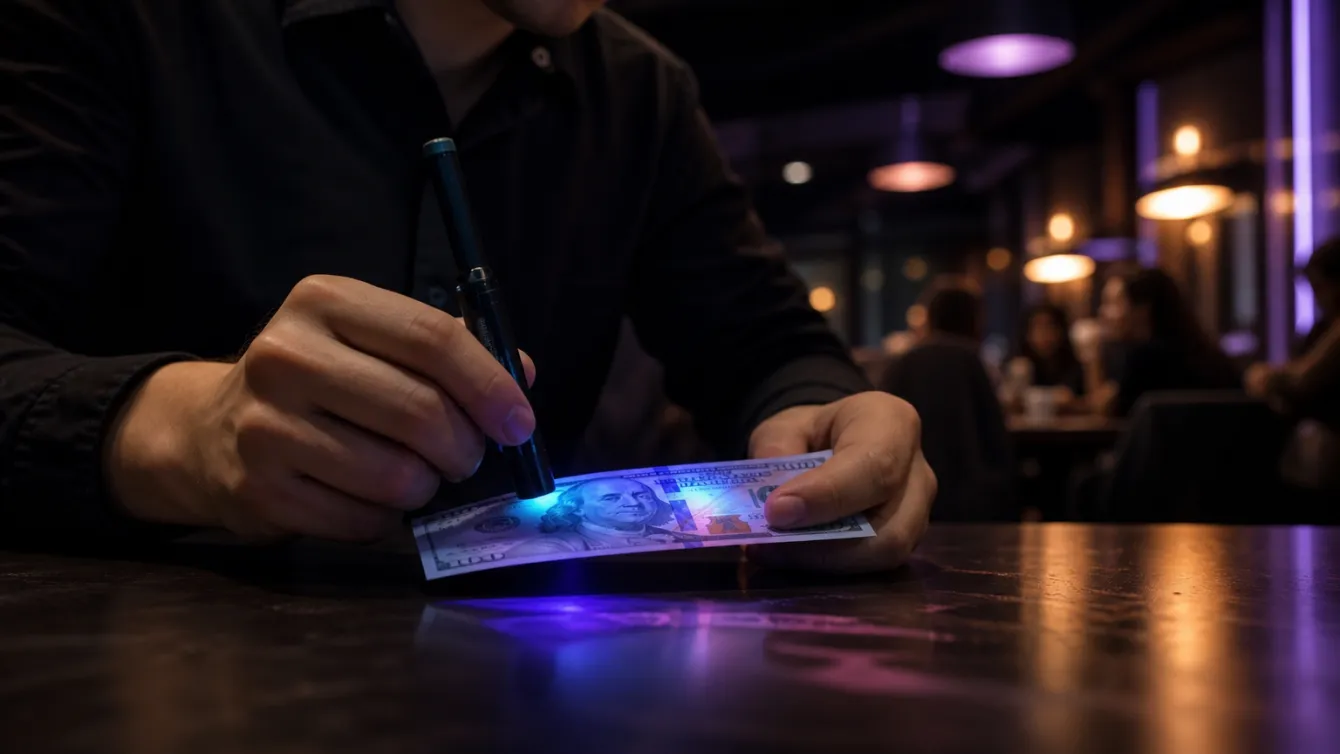
Checking the authenticity of a $100 bill using a detection pen.
To identify a counterfeit $100 bill, check for key security features: a 3-D security ribbon, a color-shifting numeral '100', and a watermark of Benjamin Franklin visible from both sides. Additionally, the security thread should read 'USA 100' and glow pink under ultraviolet light. If you suspect a counterfeit, report it to local police.
Checklist for Identifying Counterfeit $100 Bills
| Feature | Description | How to Check | Notes |
|---|---|---|---|
| 3-D Security Ribbon | Advanced security feature | Look for the ribbon | Visible when tilted |
| Watermark | Image of Benjamin Franklin | Hold to light | Visible from both sides |
| Security Thread | Reads 'USA 100' | Use UV light | Glows pink under UV |
| Color-Shifting Numeral | '100' shifts color | Tilt the bill | Changes from copper to green |
| Microprinting | Text on Franklin's collar | Use magnification | Check for 'THE UNITED STATES OF AMERICA' |
| Raised Printing | Text can be felt | Touch the shoulder area | Result of intaglio printing |
| Cash Assist App | Mobile tool for verification | Download the app | Displays security features |
| Counterfeit Detection Pens | May give false results | Test with caution | Counterfeiters can coat bills |
| Reporting Counterfeits | Notify local police | If suspected counterfeit | No reimbursement for counterfeit |
Key Features of Authentic $100 Bills
The $100 bill incorporates several advanced security features designed to prevent counterfeiting. One of the most notable features is the 3-D security ribbon, which is woven into the bill and displays moving images when tilted. This ribbon is a significant deterrent against counterfeit production due to its complexity and the technology required to replicate it1.
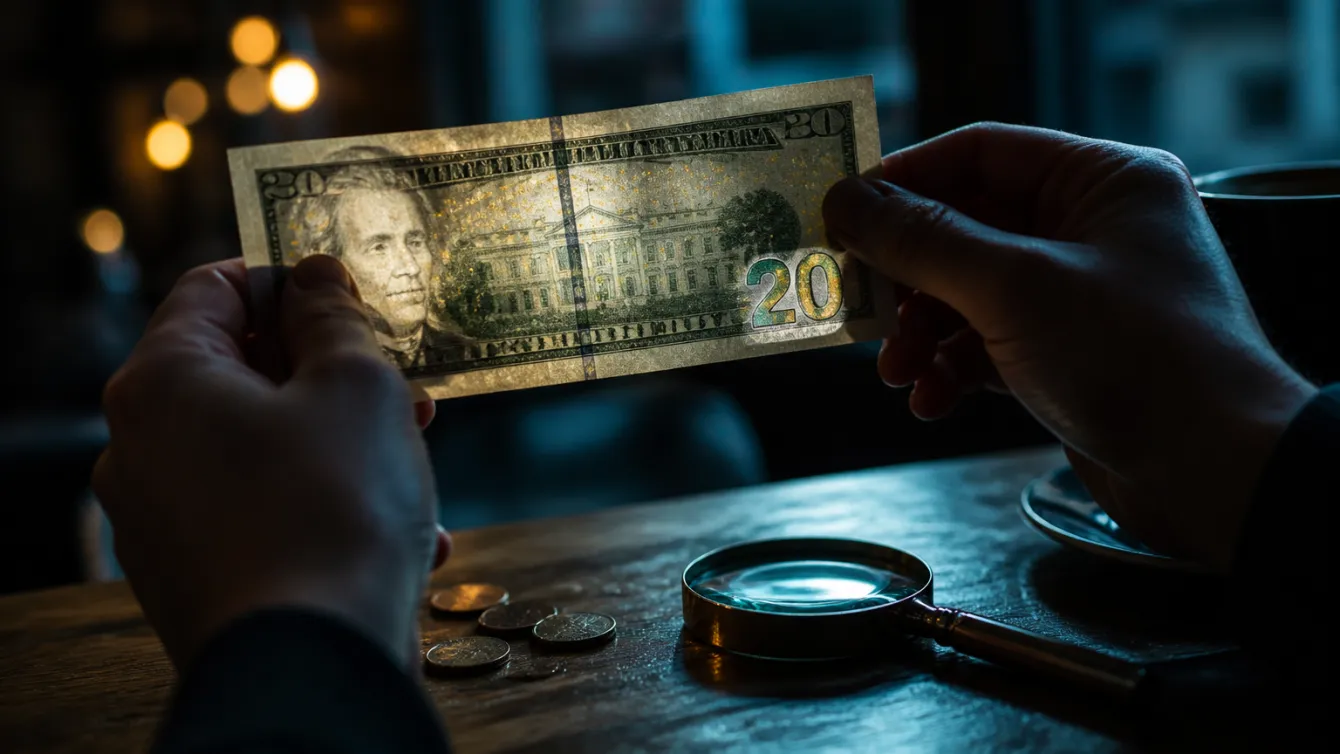
Another critical security element is the watermark of Benjamin Franklin, which is visible when the bill is held up to the light. This watermark can be seen from both sides of the bill, making it an effective verification tool2. Additionally, the bill contains a security thread that reads "USA 100." This thread glows pink when illuminated by ultraviolet light, adding another layer of protection against counterfeiting1.
The color-shifting ink is another essential feature. When the bill is tilted, the numeral '100' in the lower right corner changes from copper to green, indicating its authenticity1. Authentic $100 bills also feature microprinting, which includes tiny text that can only be seen with magnification, such as the phrase "THE UNITED STATES OF AMERICA" located on Benjamin Franklin's jacket collar1.
Furthermore, the bill has raised printing that can be felt, particularly on Franklin's shoulder, due to the intaglio printing process. This tactile feature makes it easier for individuals to detect counterfeits through touch1.
For those looking to verify the authenticity of a $100 bill, the Cash Assist mobile app can be a useful tool. This app provides a virtual simulation of the bill, allowing users to observe its unique security features3. However, caution should be exercised with counterfeit detection pens, as they may yield false results if counterfeiters coat fake notes to avoid chemical reactions4.
Understanding these key features will enhance your ability to identify genuine $100 bills and protect against counterfeit money.
Common Signs of Counterfeit $100 Bills
Identifying counterfeit $100 bills involves recognizing various indicators that deviate from authentic currency. Common signs include poor print quality, incorrect colors, and missing security features. Counterfeit bills often exhibit blurred text or images, which can be a strong indication of inauthenticity. Authentic bills have sharp, clear printing, while fakes may appear faded or uneven.
One of the most critical features to check is the watermark of Benjamin Franklin. Authentic bills display a faint image of Franklin that is visible from both sides when held up to light2. Counterfeit bills may lack this watermark or have a poorly executed version that is hard to discern. Additionally, the security thread embedded in the bill reads "USA 100" and should glow pink under ultraviolet light; a lack of this feature or incorrect illumination can signal a counterfeit1.
The color-shifting ink is another essential element. Genuine $100 bills have a numeral '100' in the lower right corner that shifts from copper to green when tilted1. Counterfeit versions may not replicate this effect accurately. Furthermore, microprinting on authentic bills, such as the text "THE UNITED STATES OF AMERICA" on Franklin's collar, can only be viewed with magnification; counterfeit bills typically do not include this detail or display it poorly1.
Texture is also a key indicator. Authentic $100 notes feature raised printing that can be felt, especially on Franklin's shoulder, due to the intaglio printing process1. Counterfeit bills often lack this tactile quality, making them feel smoother than genuine currency.
To further verify authenticity, consider using tools like the Cash Assist mobile app, which can help visualize and identify key security features3. However, be cautious with counterfeit detection pens, as they can yield false positives due to counterfeiter techniques4.
If you suspect a bill is counterfeit, it is crucial to report it to local authorities, as genuine notes will be returned, while counterfeit ones will not be reimbursed5. Understanding these signs will significantly enhance your ability to identify counterfeit $100 bills and protect yourself from fraud.
How to Use the Feel Test
The feel test is an essential method for identifying counterfeit $100 bills. One of the most significant tactile differences between real and fake currency lies in the texture and quality of the paper. Authentic $100 bills are printed on a special cotton-linen blend, giving them a distinct texture that feels crisp and firm. In contrast, counterfeit bills often use inferior paper, resulting in a smoother or even flimsy feel.
A key feature to feel for is the raised printing, particularly on Benjamin Franklin's shoulder. This raised texture is a result of the intaglio printing process used in authentic bills, which creates a tactile surface that can be easily detected when you run your fingers over the note1. Counterfeit bills typically lack this raised printing, making them feel flat and less substantial.
When conducting the feel test, pay attention to the overall print quality. Genuine $100 bills have sharp, clear images and text, while fakes may exhibit blurry or faded printing. If the bill feels too smooth or lacks the expected texture, it is likely counterfeit.
Additionally, consider the security features that can be felt. For example, the security thread embedded in the bill is another aspect that can be sensed. It is a thin strip that runs vertically and can be felt when you run your fingers along the bill. This thread should be securely integrated and not easily separable from the paper.
For best results, combine the feel test with other verification methods, such as checking the watermark and the color-shifting ink. This multi-faceted approach enhances your ability to accurately assess the authenticity of the bill. If you suspect a bill is counterfeit, report it to local authorities for proper handling5.
The Tilt Test: How It Works
The tilt test is a straightforward yet effective way to verify the authenticity of a $100 bill. When you tilt the bill, the color-shifting ink used in the numeral '100' located in the lower right corner changes from copper to green. This feature is designed to be difficult to replicate, making it a reliable indicator of authenticity1.
To perform the tilt test, hold the bill at a slight angle under a light source. Observe the numeral closely; the transition from copper to green should be smooth and noticeable. If the color does not shift or appears inconsistent, the bill may be counterfeit. This feature is part of the advanced technology integrated into the redesigned $100 note, which was introduced in 2010 to combat counterfeiting efforts6.
It's important to note that while the tilt test is a valuable verification method, it should not be used in isolation. Combine it with other checks, such as examining the watermark and the 3-D security ribbon, for a comprehensive assessment of the bill's authenticity.
For a visual demonstration of the tilt test, consider watching a video or GIF that illustrates this effect. Such resources can provide a clearer understanding of how the color-shifting ink operates in real-time. For example, the Cash Assist mobile app includes a 'Tilt Check Simulator' that allows users to interact with a virtual banknote and observe its unique features3.
By mastering the tilt test and utilizing visual aids, you can enhance your ability to identify genuine $100 bills and protect yourself from counterfeit money.
Using UV Light to Detect Counterfeits
Ultraviolet (UV) light is an effective tool for checking the authenticity of $100 bills. One of the key security features of the $100 note is the security thread, which reads "USA 100" and glows pink when illuminated by UV light1. This glowing effect is a reliable indicator that the bill is genuine. To use UV light effectively, hold the bill under a UV lamp in a darkened area. If the security thread illuminates as expected, the bill is likely authentic. If it does not glow or the thread is absent, the bill may be counterfeit.
Additionally, UV light can reveal other security features not visible to the naked eye. For example, certain areas of the $100 bill contain fluorescent fibers that will also shine under UV light. Authentic bills exhibit a variety of colors when exposed, while counterfeit notes may not replicate this feature accurately.
When selecting a UV light tool, consider options such as handheld UV flashlights or dedicated UV currency detectors. Here are some recommended tools:
Handheld UV Flashlight: Portable and easy to use, ideal for quick inspections.
UV Currency Detector: A tabletop device designed specifically for checking bills, offering a more comprehensive analysis.
Multi-functional UV Light: Some devices combine UV light with other detection methods, such as magnification, enhancing overall verification capabilities.
It is important to note that while UV light is a powerful verification tool, it should not be the sole method of authentication. Combining it with other checks, such as the tilt test and feel test, will provide a more thorough assessment of the bill's authenticity. If you suspect a counterfeit bill after using UV light, report it to local authorities for further investigation5.
Checking Serial Numbers and Other Details
Verifying the serial numbers on a $100 bill is a crucial step in determining its authenticity. Each genuine bill has a unique serial number printed in black ink on the front, located in the upper right corner and the lower left corner. To check the serial number, compare it with the numbers on other bills you know to be authentic. Authentic serial numbers are evenly spaced and printed clearly. If the numbers are blurry, uneven, or misaligned, the bill may be counterfeit.
In addition to the serial numbers, other details can help confirm authenticity. The redesigned $100 note features advanced security elements such as the 3-D security ribbon and color-shifting ink, which are difficult to replicate1. When examining the bill, hold it up to the light to reveal the watermark of Benjamin Franklin, which should be visible from both sides2.
For online verification, resources are available to help confirm the authenticity of a $100 bill. Websites and mobile apps, such as the Cash Assist mobile app, can provide users with information about security features and allow them to compare their bills against known authentic images3. This app includes a 'Tilt Check Simulator' to demonstrate the color-shifting properties of the ink3.
Another method to enhance verification is to check the security thread embedded in the bill. This thread should read "USA 100" and glow pink under ultraviolet light1. Using a UV light source can reveal this feature effectively, confirming the bill's legitimacy.
If counterfeit currency is suspected, it is essential to report it to local authorities. Genuine notes will be returned, while counterfeit ones will not be reimbursed5. By combining serial number checks with other verification methods, individuals can significantly reduce the risk of accepting counterfeit money.
What to Do If You Suspect a Counterfeit Bill
If you receive a suspected counterfeit $100 bill, taking immediate and appropriate action is crucial. First, handle the bill as little as possible to preserve any evidence. Avoid returning the bill to the person who gave it to you, as this can complicate the investigation and potentially lead to legal issues.
The next step is to report the incident to local authorities. This can be done by contacting your local police department. They will provide guidance on how to proceed and may take the bill for further examination. If the bill is genuine, it will typically be returned to you; however, if it is counterfeit, you will not be reimbursed for the loss5.
In addition to local police, the U.S. Secret Service recommends reporting counterfeit currency to the nearest field office. They have specialized training and resources to handle counterfeit cases effectively7. You can find contact information for your local Secret Service field office on their official website.
When reporting, be prepared to provide details about how you received the bill, including the date, time, and location, as well as any information about the person who gave it to you. This information can aid in the investigation.
It is also beneficial to educate yourself about the security features of authentic $100 bills, such as the watermark and color-shifting ink. Familiarizing yourself with these features can help you avoid accepting counterfeit bills in the future12. For additional resources, consider using tools like the Cash Assist mobile app, which helps identify key security features of currency3.
Taking these steps can enhance your fraud prevention efforts and contribute to the broader fight against counterfeit money.
Counterfeit Detection Tools and Resources
To effectively identify counterfeit $100 bills, a combination of tools and resources can enhance your verification process. One common tool is the counterfeit detection pen, which reacts with the paper to indicate authenticity. However, these pens can produce false results if counterfeiters coat fake notes to prevent chemical reactions4. Thus, they should not be solely relied upon.
Another practical tool is the Cash Assist mobile app. This app can help users identify the denomination of a bill and display key security features visible on genuine currency3. It includes a 'Tilt Check Simulator' that allows users to interact with a virtual banknote to observe its unique features, making it a valuable resource for both learning and verification3.
For those looking to deepen their understanding of currency verification, official government resources are available. The U.S. Secret Service provides guidelines on how to report counterfeit notes and offers detailed information about security features7. Additionally, the Federal Reserve has resources that outline the advanced security features of the redesigned $100 bill, such as the 3-D security ribbon and color-shifting ink, introduced in 20106.
When inspecting a bill, consider utilizing UV light to check for the security thread, which glows pink under ultraviolet light1. Handheld UV flashlights or dedicated currency detectors can be effective in revealing these features.
In summary, using a combination of tools such as the Cash Assist app, UV light, and understanding the limitations of counterfeit detection pens can significantly improve the accuracy of identifying counterfeit $100 bills. For further learning, resources from the Federal Reserve and the U.S. Secret Service are essential for staying informed about currency security features and fraud prevention.
Emerging Trends in Counterfeit Currency
Recent advancements in counterfeit technology have made it increasingly challenging to identify fake $100 bills. Counterfeiters are using high-resolution printers and sophisticated techniques that can mimic security features found in genuine currency. As a result, the detection rates for counterfeit bills have fluctuated. According to the U.S. Secret Service, the rate of counterfeit detection is approximately 0.01% of all currency in circulation, highlighting the effectiveness of existing security measures7.
One of the most notable security features introduced in the redesigned $100 note is the 3-D security ribbon, which is difficult to replicate. This ribbon, along with the color-shifting ink and the security thread that glows pink under UV light, significantly enhances the bill's authenticity verification process1. Additionally, microprinting, such as the text on Benjamin Franklin's collar, adds another layer of complexity for counterfeiters1.
To keep pace with evolving counterfeiting methods, consumers should be vigilant and knowledgeable about the latest security features. For example, holding the bill to light reveals a watermark of Benjamin Franklin, which should be visible from both sides2. Moreover, the use of mobile applications like Cash Assist can aid users in identifying genuine currency by displaying key security features and allowing for interactive simulations3.
Awareness of these emerging trends is essential for effective currency verification. As counterfeit technology continues to advance, understanding the specific security features of the $100 bill and utilizing available resources will be crucial in combating counterfeit money.
Common Mistakes and Misconceptions
Relying Solely on Counterfeit Detection Pens
Many individuals believe that counterfeit detection pens are foolproof tools for identifying fake bills. However, these pens can yield false results since counterfeiters may coat fake notes to prevent proper chemical reactions4. It is crucial to combine the use of detection pens with other verification methods, such as UV light checks and visual inspections of security features.
Overlooking Key Security Features
A common mistake is not thoroughly examining the security features of the $100 bill. Features like the 3-D security ribbon and the color-shifting ink are designed to be easily identifiable1. Failing to check these elements can lead to accepting counterfeit bills. It is essential to familiarize oneself with these features to enhance detection efforts.
Ignoring the Importance of the Watermark
Some people may not realize the significance of the watermark in verifying a $100 bill’s authenticity. The watermark depicting Benjamin Franklin is visible from both sides when held to the light2. Neglecting this step can result in misidentifying counterfeit currency, as the watermark is a critical security element.
Misunderstanding What to Do After Receiving a Counterfeit Bill
Many individuals are uncertain about the appropriate steps to take when they suspect they have received a counterfeit bill. It is important to report it to local authorities promptly5. Not doing so can complicate the situation, as genuine bills are typically returned, but counterfeit ones will not be reimbursed.
Lack of Awareness of Available Tools and Resources
A frequent oversight is the underutilization of available tools and resources for counterfeit detection. Mobile applications like Cash Assist can provide valuable assistance in identifying key security features3. Educating oneself on these resources can significantly improve the accuracy of currency verification and help in recognizing counterfeit bills.
Conclusions
Familiarize yourself with the security features of the $100 bill, including the 3-D security ribbon and color-shifting ink.
Always check for the watermark of Benjamin Franklin by holding the bill up to the light.
Utilize tools like the Cash Assist mobile app for interactive verification and learning about security features.
Report suspected counterfeit bills to local authorities promptly to aid investigations and avoid legal complications.
Combine multiple verification methods, such as UV light checks and visual inspections, for accurate identification.
To enhance your understanding of counterfeit detection, consider exploring How to Spot a Fake 20 Dollar Bill.
Q&A
How can I tell if a $100 bill is real or fake?
To determine if a $100 bill is real, hold it up to the light to check for the watermark of Benjamin Franklin, which should be visible from both sides2. Additionally, look for the color-shifting ink on the lower right corner, where the numeral '100' changes from copper to green when tilted1.
Are there fake $100 bills that look real?
Yes, counterfeit $100 bills can closely resemble genuine ones due to advanced printing technology. Counterfeiters often replicate security features, making it challenging for the average person to distinguish between real and fake currency6. Therefore, it's essential to know the specific security features of authentic bills.
What happens if you get a counterfeit $100 bill?
If you receive a counterfeit $100 bill, you should report it to local authorities immediately. Genuine bills will typically be returned, but counterfeit ones will not be reimbursed5. It's important to handle the bill as little as possible to preserve evidence for the investigation.
What are the security features of a $100 bill?
The $100 bill includes several security features such as a 3-D security ribbon, a color-shifting bell in the inkwell, and a security thread that reads 'USA 100' and glows pink under ultraviolet light1. Additionally, it has microprinting and raised printing that can be felt1.
How can I check the serial number on a $100 bill?
To check the serial number on a $100 bill, locate it on the front of the bill, typically in the upper right corner and the lower left corner. Ensure that the serial numbers match and are printed clearly without any smudging or irregularities, as counterfeit bills may have inconsistent or poorly printed serial numbers.
What tools can help me detect counterfeit money?
Tools such as the Cash Assist mobile app can assist in identifying the denomination of a bill and displaying key security features3. Additionally, UV light sources can reveal the glowing security thread, which is crucial for verification1. Counterfeit detection pens are also available, but they may yield false results and should not be solely relied upon4.
What should I do if I receive a counterfeit bill?
If you suspect you have received a counterfeit bill, do not return it to the person who gave it to you. Instead, report the bill to local police or the nearest U.S. Secret Service field office7. Provide details about how you received the bill, as this information can aid in the investigation.
Explore More on Currency Security
Discover additional resources to enhance your knowledge.